Examina Physio · iPhone · iPad · Mac · For physiotherapists
Measure it once,
then measure it again.
Examina Physio guides a physiotherapist through an assessment centred on function, activity and participation: reason and goals, history of the problem, pain and symptoms, posture and movement, joint mobility, strength, sensation, balance and gait, and the context the person lives in.
Range of motion, strength and circumferences are recorded one row at a time with joint, side, movement, value and method. At every re-assessment they line up by date next to the pain map of each session, exactly as entered, with no thresholds and no verdicts.
Version 1.0 · iPhone, iPad and Mac · 9 languages · Free for up to five patients, Examina Pro for more
Works offline · No account · Clinical content encrypted on the device
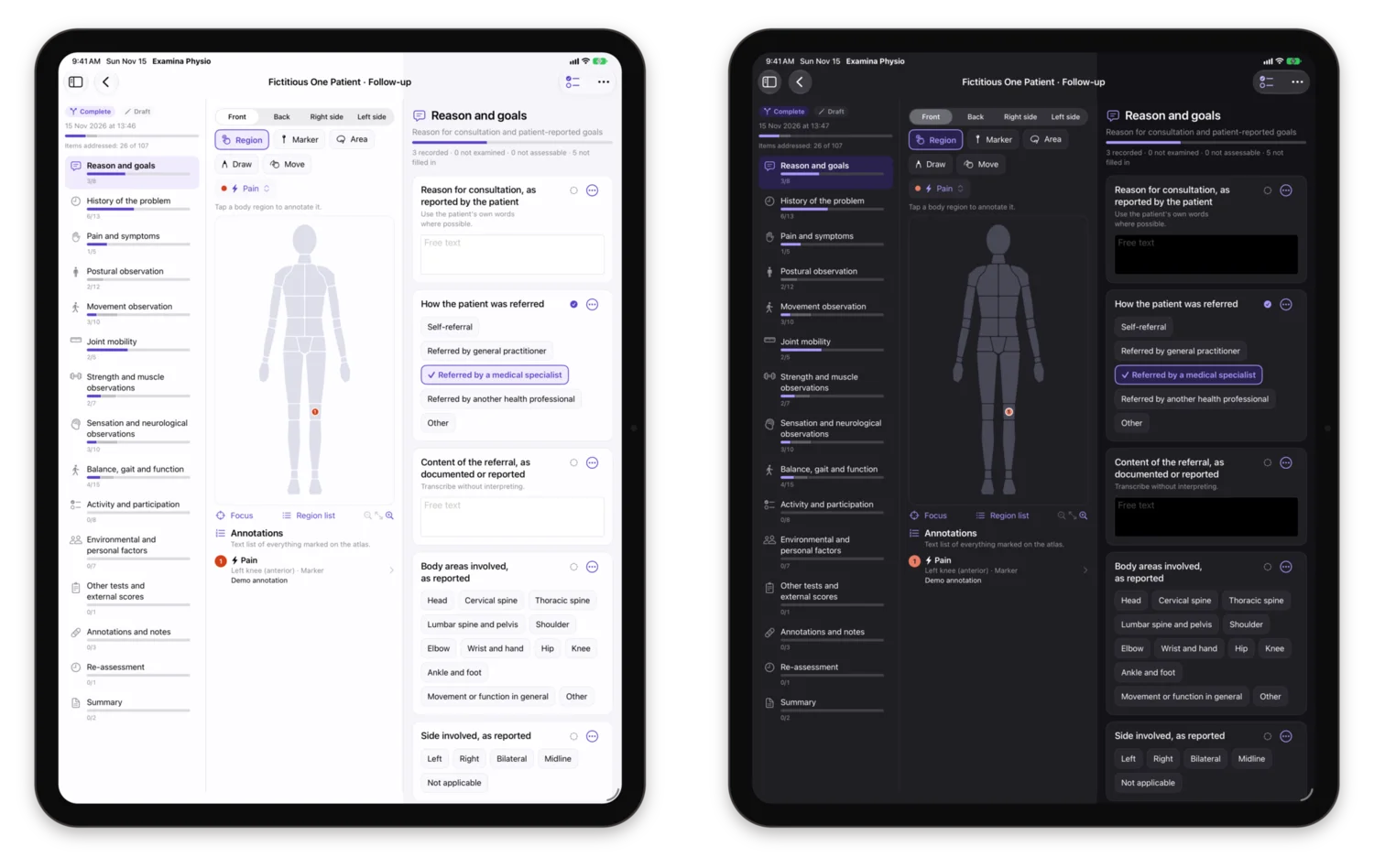
The same session on iPad, in light and dark appearance.
Progress you can show, not remember
Rehabilitation is a sequence of sessions, and its evidence is a sequence of numbers: how far the shoulder lifted in March, how far it lifts now. On paper those numbers end up on different sheets, in different units, without the method that produced them, and the comparison is done from memory.
Examina Physio records each measurement with the joint, the side, active or passive, the instrument and the position, and keeps every session. The comparison over time is then a screen, not an effort, and it shows only what you measured.
Measurements with method
Range of motion, strength tests and limb circumferences, one repeatable row each, with side, method and conditions.
Pain map
Pain, limitation and sensation placed on the body with their side, and compared session by session.
Over time
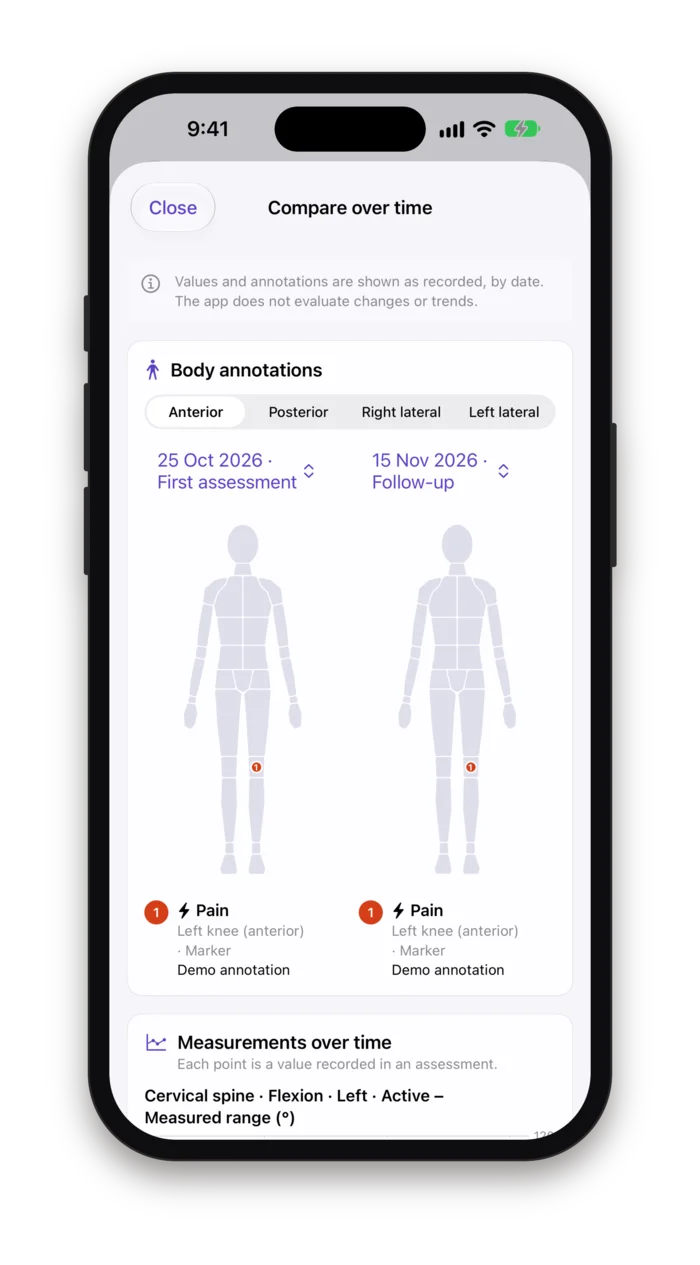
Every recorded value plotted by date, two sessions side by side on the atlas. No targets, no colours, no judgement.
The assessment, from goals to re-assessment
The structure follows function, activity, participation and context. Follow-up questions open only when an answer calls for them: report restricted movement and the joint mobility table appears; mark a re-assessment and the questions about the previous session follow.
15 sections, 107 items. Original wording following the general approach of the WHO ICF model and physiotherapy documentation practice; no ICF codes, qualifiers or licensed instruments are reproduced.
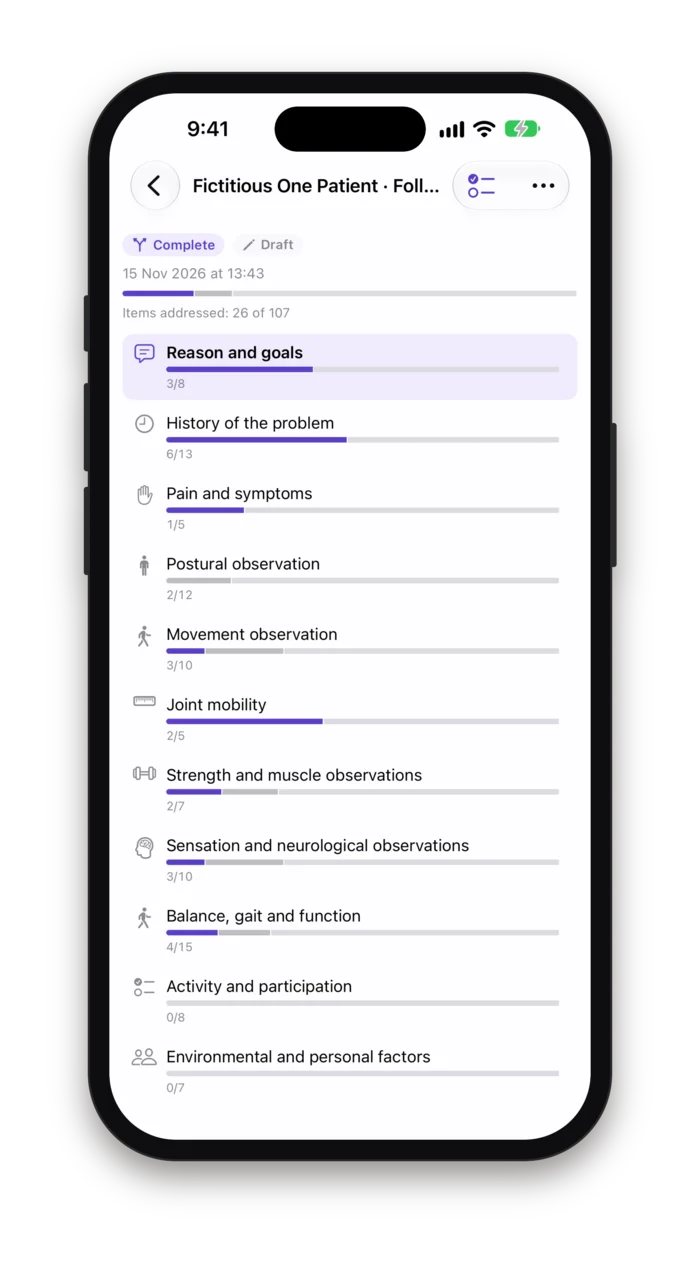
- 01Reason and goals
- 02History of the problem
- 03Pain and symptoms
- 04Postural observation
- 05Movement observation
- 06Joint mobility
- 07Strength and muscle observations
- 08Sensation and neurological observations
- 09Balance, gait and function
- 10Activity and participation
- 11Environmental and personal factors
- 12Other tests and external scores
- 13Annotations and notes
- 14Re-assessment
- 15Summary
- Complete
- Every section in order, for a first session or whenever the whole picture is needed.
- Rapid
- A declared subset of the main items, marked in the template, for a follow-up or a busy session. You can still open any other section.
- Focused
- Pick one or more areas and only their sections are shown: cervical spine and head, shoulder, elbow, wrist and hand, thoracic and lumbar spine, hip, knee, ankle and foot, balance and gait, neurological and functional area, activity, participation and context.
The atlas at the centre of the session
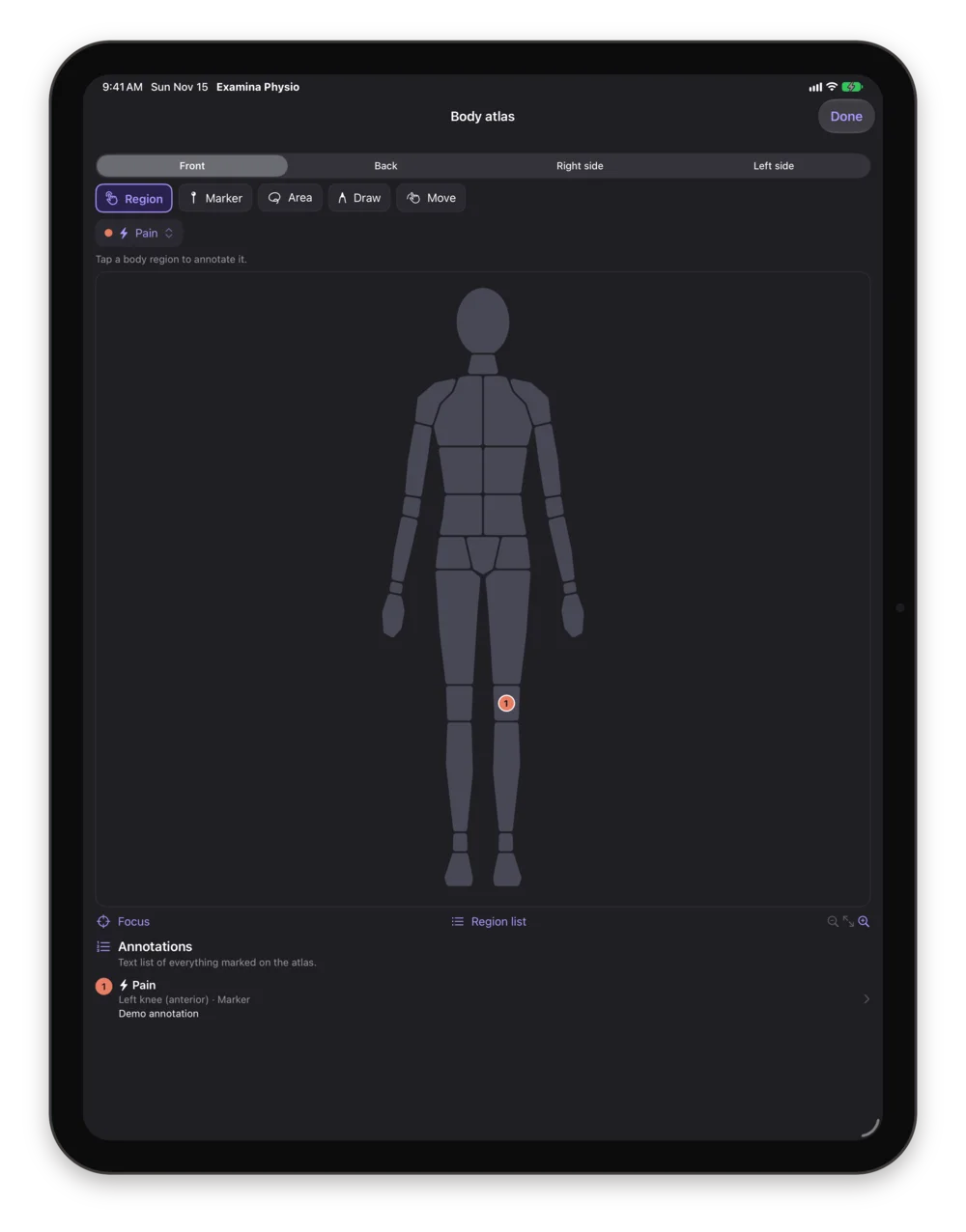
On iPad and Mac the atlas sits in the middle of the assessment, between the sections and the questions, because in physiotherapy the body is where most answers point. Map where the pain is, where movement is limited and where sensation changes, on the correct side, and compare the map with the previous session.
- Four views
- Front, back, right side and left side, with regions grouped by head and neck, chest, abdomen, back, upper limb, hand, lower limb and foot.
- Region, marker, area, drawing
- Tap a region, drop a marker on a point, outline an area or draw freely, with Apple Pencil on iPad. Every annotation can be moved, edited or removed.
- Structured, not just a picture
- Each annotation stores the anatomical region and the side as data, next to its geometry. A later redraw of the atlas cannot move a documented finding, and the text list reads without the image.
- Linked to the questions
- Questions about a site open the atlas with the relevant regions highlighted; the annotations appear in the review and in the exported document.
Annotation categories in Examina Physio
- Pain
- Limitation
- Sensation
- Observed finding
- Other
Range of motion, strength, function
The measuring sections are tables you fill one row at a time. Each row keeps everything needed to repeat the measurement next time in the same way, and to read it correctly later.
- Joint mobility
- Joint, side, movement, active or passive, measured range, method or instrument, position, symptoms during the movement and end-feel as you describe it.
- Strength
- Muscle or group, side, test, method and instrument, measured force or load, manual grade as you recorded it, repetitions and conditions. Plus tone, bulk, palpation and limb circumferences.
- Posture and movement
- Anterior, lateral and posterior observation, alignment segment by segment from head to feet, sitting posture, and how the person moves.
- Re-assessment
- Date of the previous session, the course since then as the patient reports it, the agreed activities carried out, new events or symptoms.
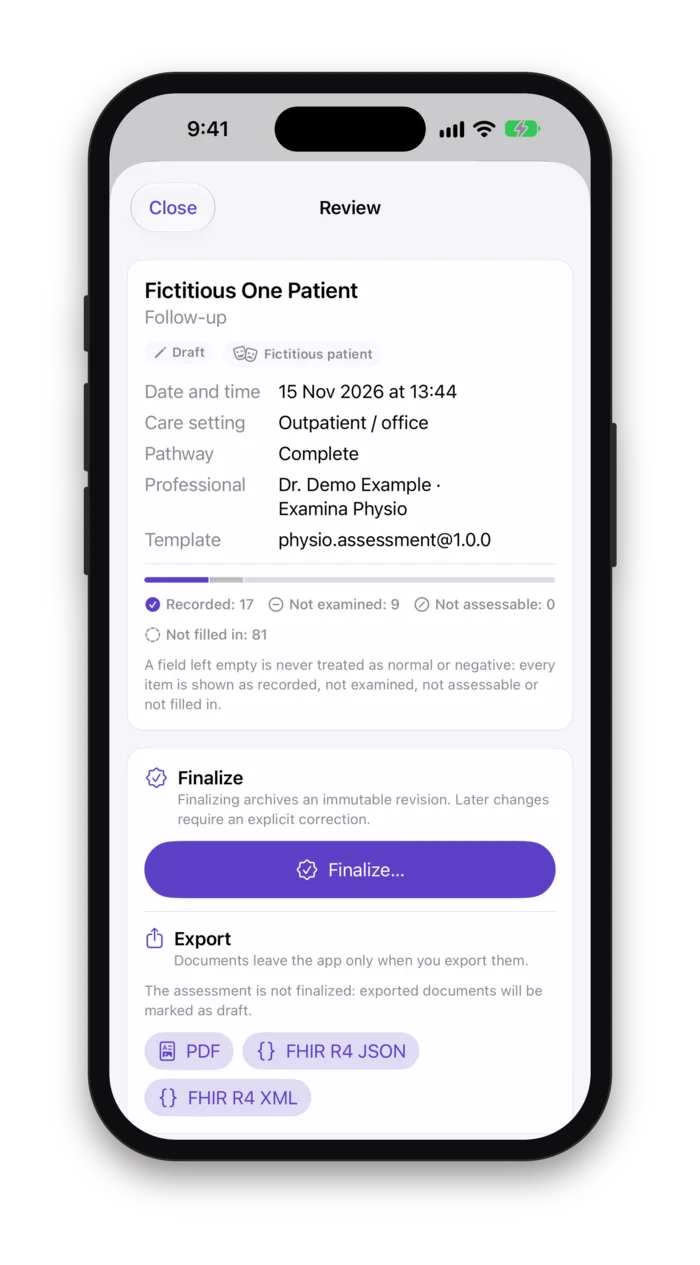
An empty field is not a normal one
Paper forms and most templates have the same flaw: a box left blank reads as nothing to report. In Examina Physio every item carries an explicit state, the review counts them, and the exported document says which parts were never filled in.
Recorded
An answer, a value or a note was entered.
Not examined
You chose not to examine or ask this time.
Not assessable
It could not be assessed, with an optional reason.
Not filled in
Left empty, and shown as such: never as normal or negative.
- Review
- The whole assessment on one sheet: patient, date, setting, pathway, author and template version, the count of each state, then every section as recorded, each with an Edit link.
- Finalize
- Finalizing archives an immutable revision. Later changes need an explicit correction, and the earlier versions stay in the history.
- Export, only when you ask
- A readable PDF, or with Examina Pro an HL7 FHIR R4 document in JSON or XML, through the share sheet or the save panel. A draft exports marked as draft. Each export leaves a trace in the app with its SHA-256 fingerprint, format and declared destination.
One app on every Apple screen
Examina Physio is a single universal app. On iPhone the session is a vertical list of sections and the atlas opens full screen. On iPad the sections, the questions and the atlas sit side by side, with Apple Pencil for drawing. On the Mac it is a native window with a sidebar, search and keyboard shortcuts.
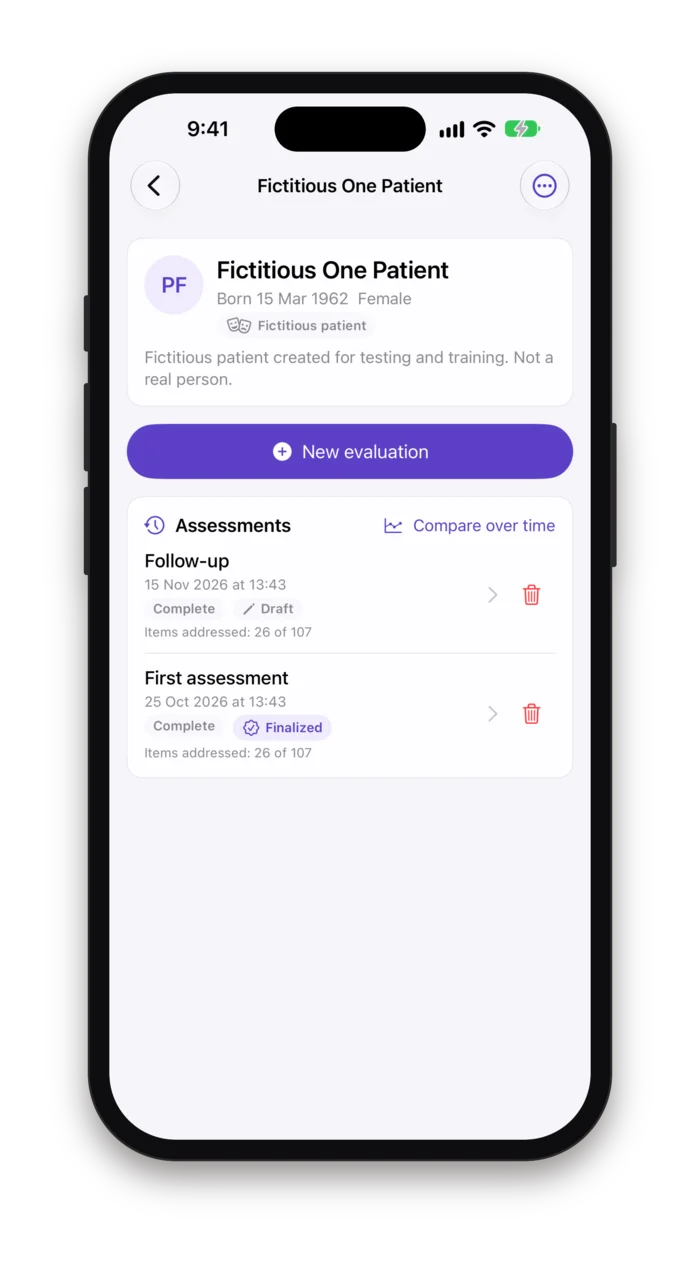
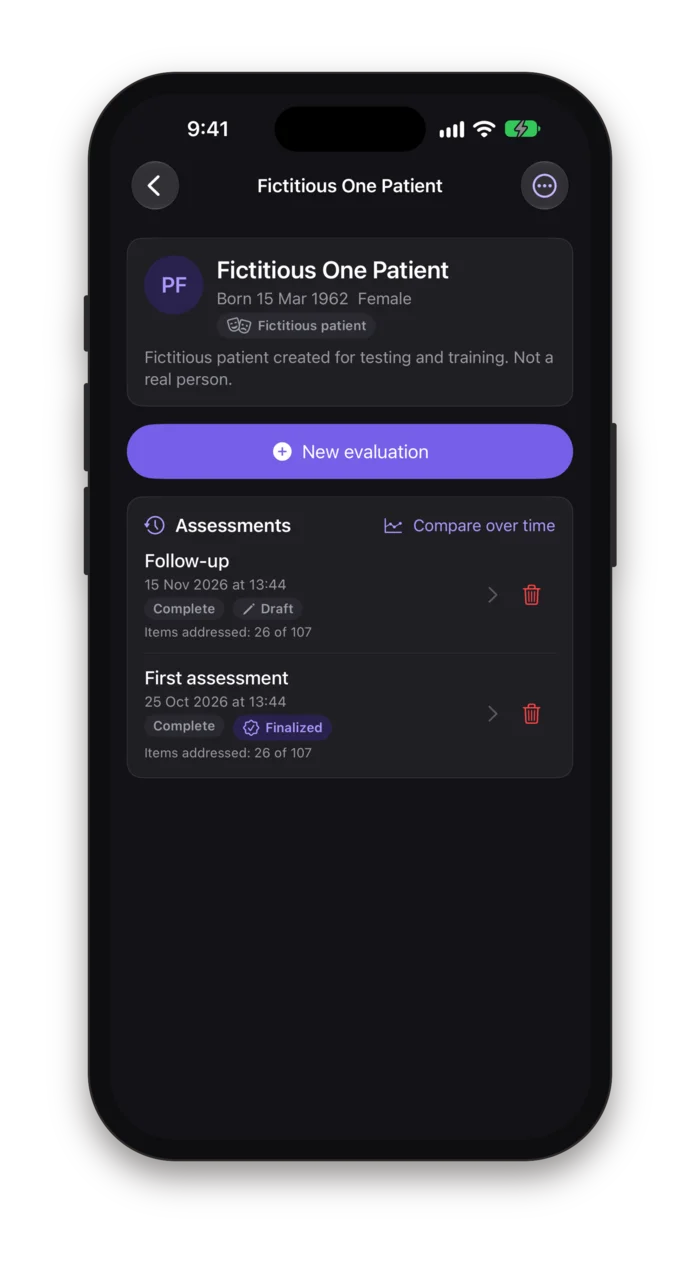
iPhone, light and dark
The patient record with its sessions and the comparison over time. Every screen follows the light or dark appearance set on the device.
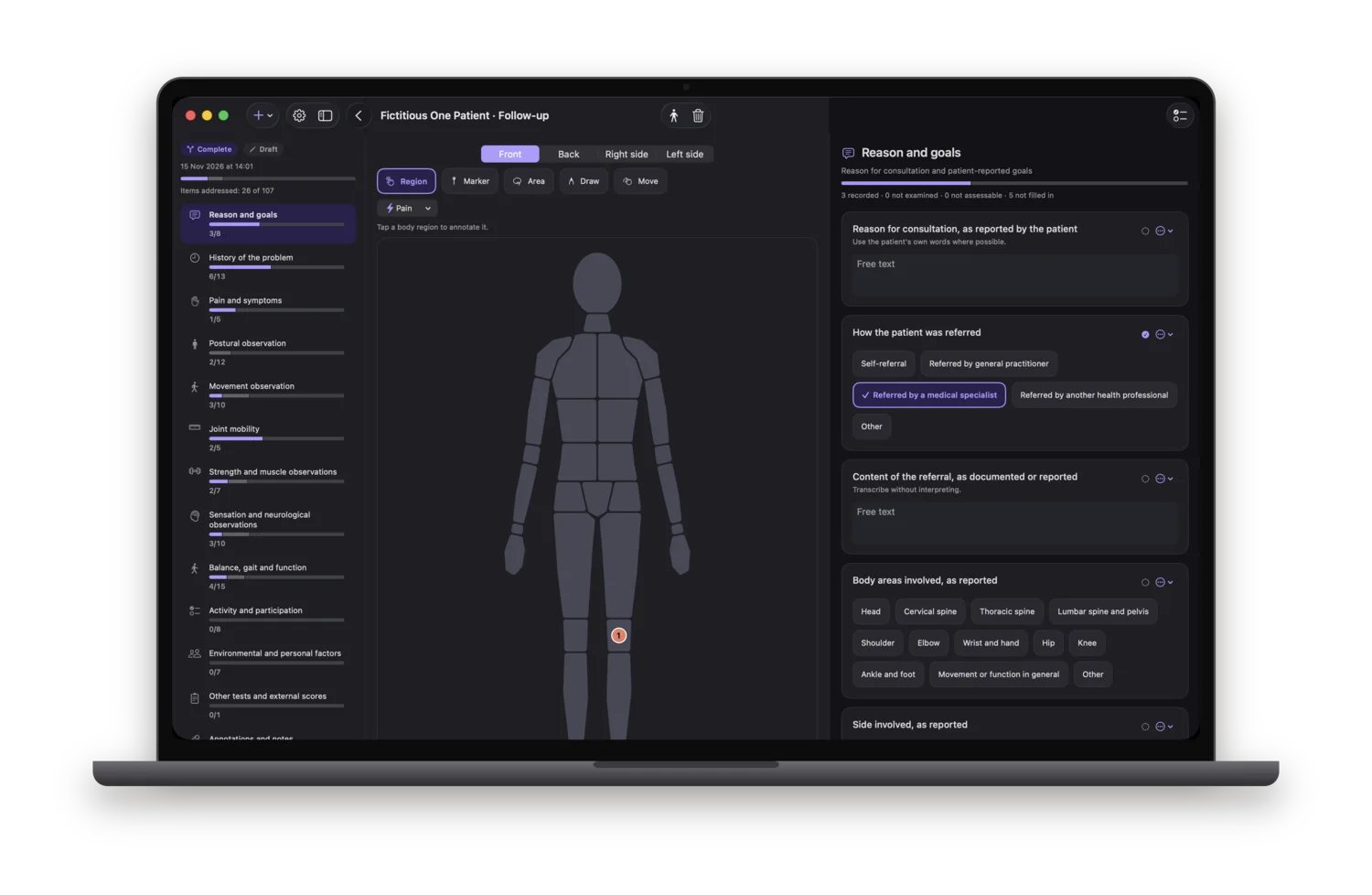
Mac
Three columns: the sections with their progress, the atlas in the middle, the questions of the current section on the right. Native macOS, not an iPad app in a window.
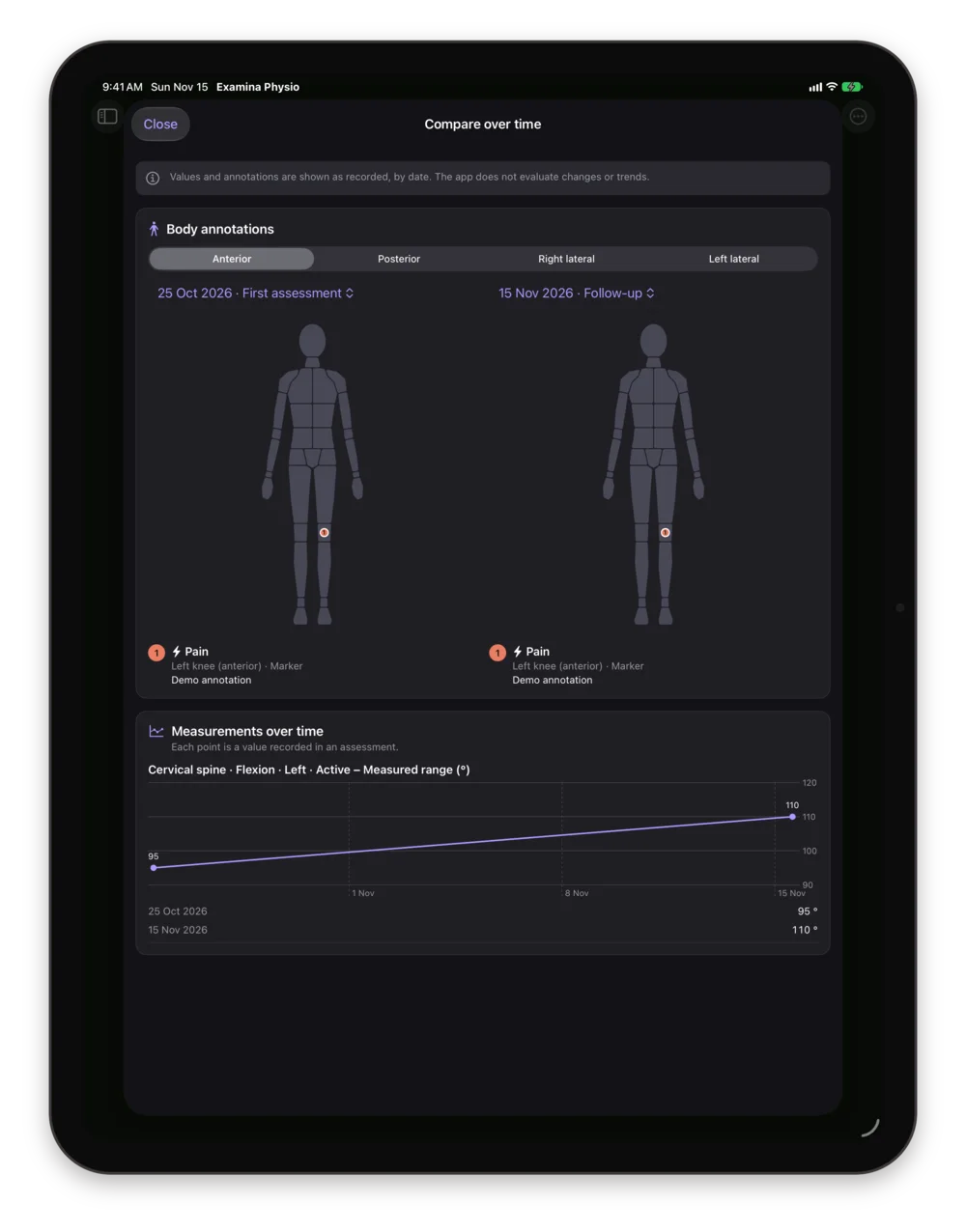
iPad
Two sessions side by side on the atlas, with every recorded value plotted by date below.
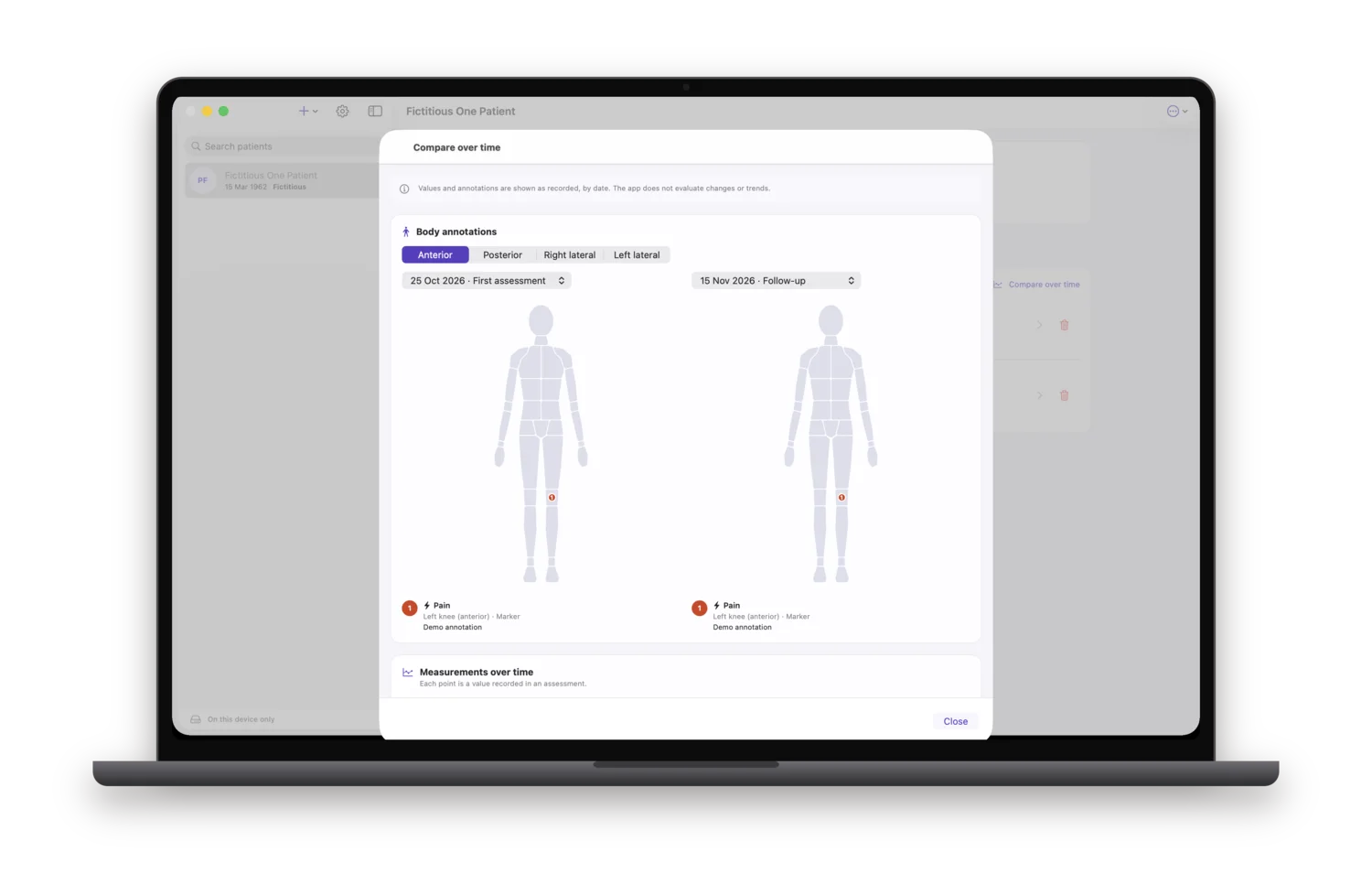
Compare over time
The same comparison on the Mac. Values and annotations are shown as recorded; the app does not evaluate changes or trends.
Patient data stays with you
There is no Arpacore server, no account and no clinical database of ours. The records live in the app on your device, encrypted by the app itself, and leave it only when you export a document or turn on sync with your own iCloud.
Encrypted by the app
Every record is sealed with ChaCha20-Poly1305 before it is written, with a 256-bit key kept in the Keychain. Only the record type, opaque identifiers and dates stay readable.
iCloud only if you want it
Sync between your own iPhone, iPad and Mac comes with Examina Pro and is off by default. Turned on, it uses your private CloudKit database, and records travel already encrypted. Each Examina app has its own container.
Nothing collected
No account, no developer server, no analytics, no advertising, no third-party SDKs, and no clinical content in logs. App Store privacy label: Data Not Collected.
App lock
Optional Face ID, Touch ID or device passcode to open the app, and the content hidden in the app switcher.
Photos without metadata
Images from the photo library or files are re-encoded without location, camera model or capture date, after you confirm consent.
Erase everything
One action in Settings removes all data, from this device only or from iCloud too. A local audit log records what happened, without clinical content.
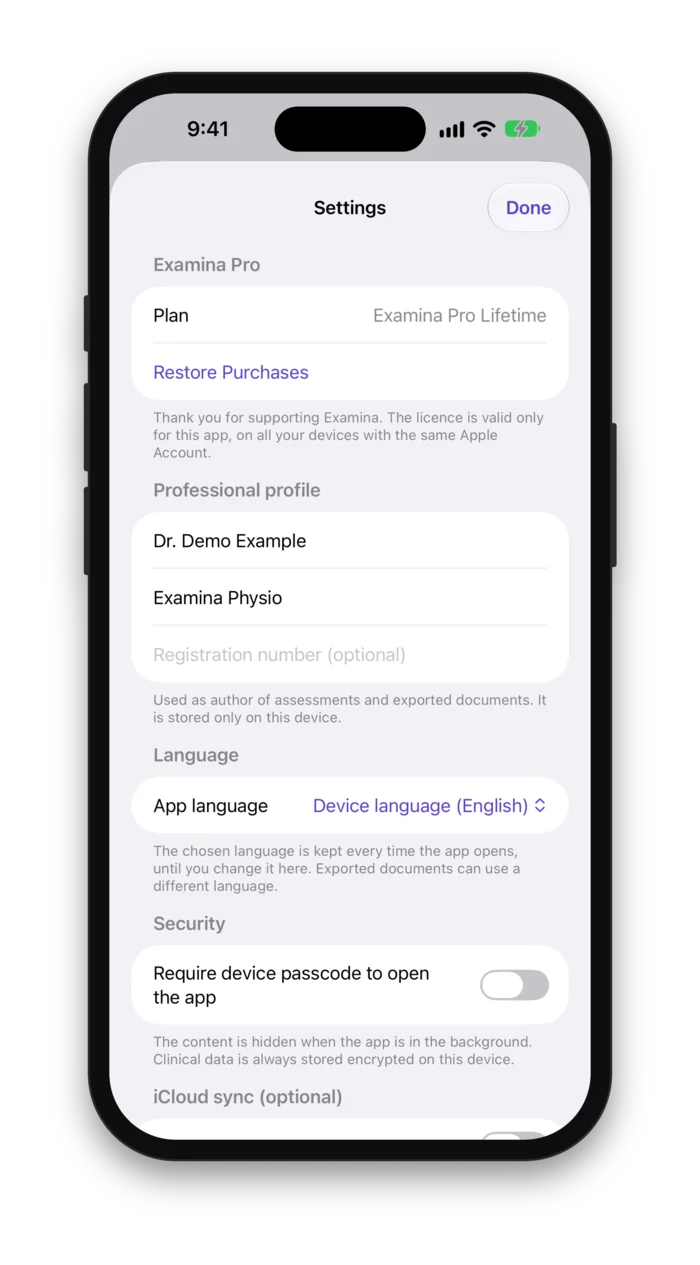
Free to start, Pro when you need more
Every documentation feature is free. Examina Pro lifts the patient limit and adds the two features that move data beyond one device: FHIR export and iCloud sync.
Free
$0
- Every pathway, section and question of the template
- The body atlas with all its tools
- Review, finalized revisions and comparison over time
- PDF export
- App lock, recovery key and erase all data
- Up to five patients, fictitious ones included
Examina Pro
Everything in Free, plus
- Unlimited patients
- HL7 FHIR R4 export, JSON and XML
- iCloud sync between your iPhone, iPad and Mac
- Monthly
- $4.99
- per month
- Yearly
- $39.99
- per year, 1-week free trial
- Lifetime
- $99.99
- one-time purchase
- The three plans unlock exactly the same features. The free trial is for new yearly subscribers.
- One purchase covers iPhone, iPad and Mac with the same Apple Account. Each Examina app has its own licence.
- If a subscription ends, nothing is deleted or locked: you can still open, edit and export to PDF everything you recorded. iCloud sync pauses until you renew.
- US prices. The App Store shows the price in your currency. Subscriptions renew automatically and can be cancelled in your Apple Account settings.
What it deliberately does not do
Examina Physio records what you observe and what the patient reports. Clinical judgement stays with you, so the app leaves out everything that would try to make it for you.
- No diagnoses or diagnostic suggestions
- No suggested treatments or interventions
- No triage and no alerts
- No calculated or interpreted scores
- No thresholds or colours that judge a value
- No measurements from device sensors
Who it is for
Musculoskeletal practice
Spine, shoulder, knee and the rest, with the focused pathway for the region you are treating and the measurements compared at every session.
Private physiotherapists
A structured record of each course of treatment, and a PDF to hand to the patient or the referring physician.
Neuro and balance work
Sensation, balance, gait and function documented as observed, with tests and external scores transcribed as obtained.
Students and tutors
The full assessment as a checklist, and a habit of recording the method next to every number.
A structured physiotherapy assessment on iPhone, iPad and Mac. Coming soon to the App Store.
Examina Physio is a documentation tool for healthcare professionals, not for patients. It does not make diagnoses, suggest treatment, perform triage, raise alerts or calculate scores, and it does not replace professional judgement or the clinical record your organisation requires. Before turning on iCloud sync or exporting a document, check that this is allowed where you work. The screenshots show a fictitious patient created by the app for testing; no real person is depicted.