MedBattle · Apple TV · tvOS 18 or later
5,931 medical questions
worth arguing about.
MedBattle is a party game about medicine for two to six people in the same room, playing on one television. Six subjects, two halves, one wheel to fill. Nobody studies alone, and nobody gets to look anything up.
One person answers while everybody else reads the same question and quietly hopes they miss it.
Two to six players · English and Italian · One-time purchase, no subscription
No account · No sign-in · No analytics · No tracking

Revision, minus the revising
Everybody who has sat a medical state examination has the same question bank sitting on a hard drive somewhere. It is answered the same way every time: alone, at a desk, against a timer, with nobody to blame and nobody to gloat at.
MedBattle takes that bank and puts it on the television, with your friends around it. The recall is identical. The evening is not — because the interesting part of any question was never the answer, it was the two people at the table who were certain and disagreed.
Six subjects, two halves, one wheel to fill
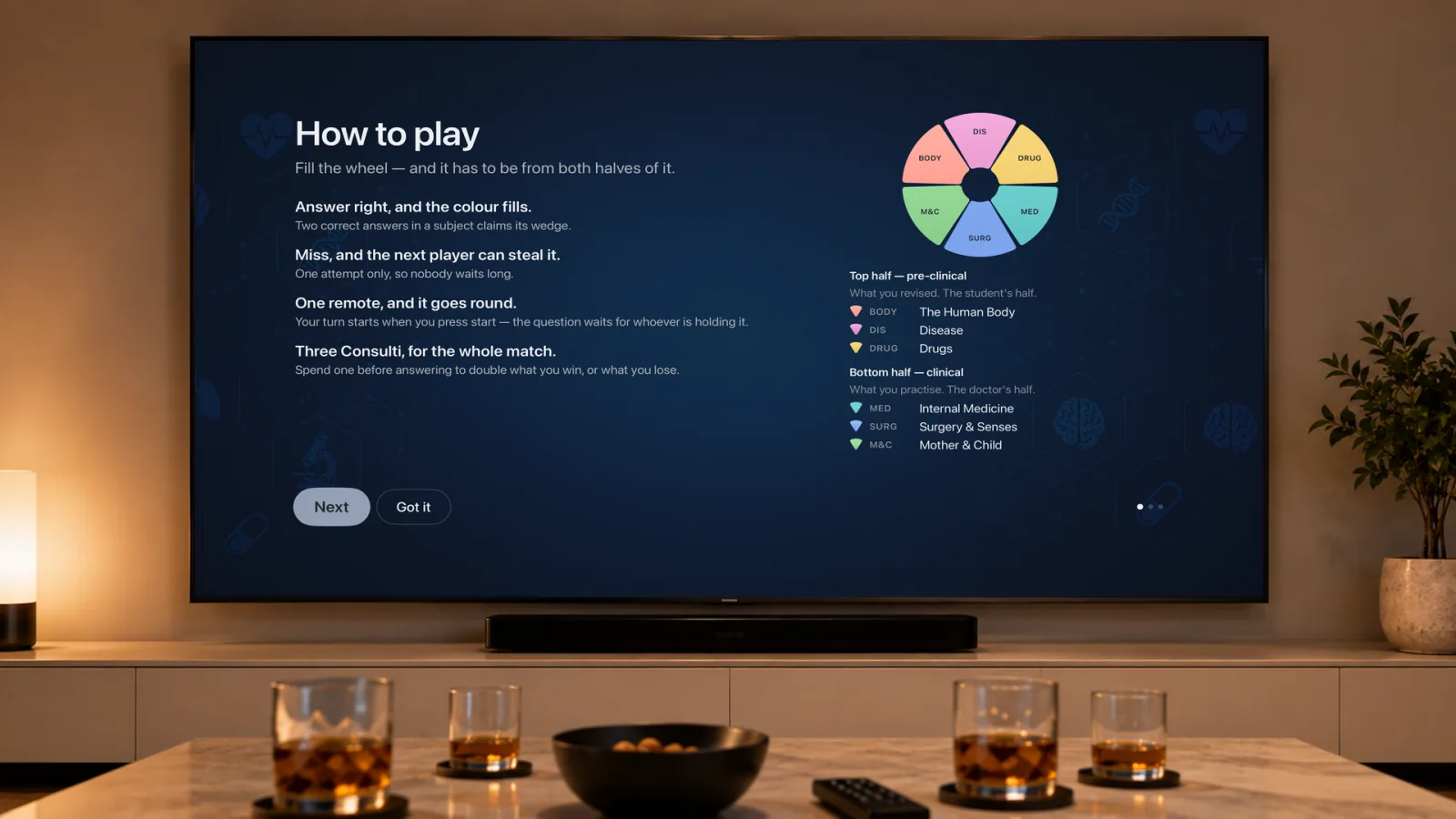
Two correct answers in a subject claims its wedge. The six subjects split into two halves — the pre-clinical half you revised and the clinical half you practise — and winning means taking wedges from both. There is no quietly camping in the half you happen to be good at.
Top half — pre-clinical
What you revised. The student’s half.
- BODY
The Human Body
Anatomy, histology, physiology — how it is built and how it runs.
- DIS
Disease
Pathology, microbiology and immunology — what goes wrong, and why.
- DRUG
Drugs
Pharmacology: mechanisms, classes and the side effects nobody remembers.
Bottom half — clinical
What you practise. The doctor’s half.
- MED
Internal Medicine
The bread and butter of the ward, from cardiology to endocrinology.
- SURG
Surgery & Senses
Surgical practice alongside ophthalmology, ENT and dermatology.
- M&C
Mother & Child
Obstetrics, gynaecology and paediatrics — the half nobody splits evenly.
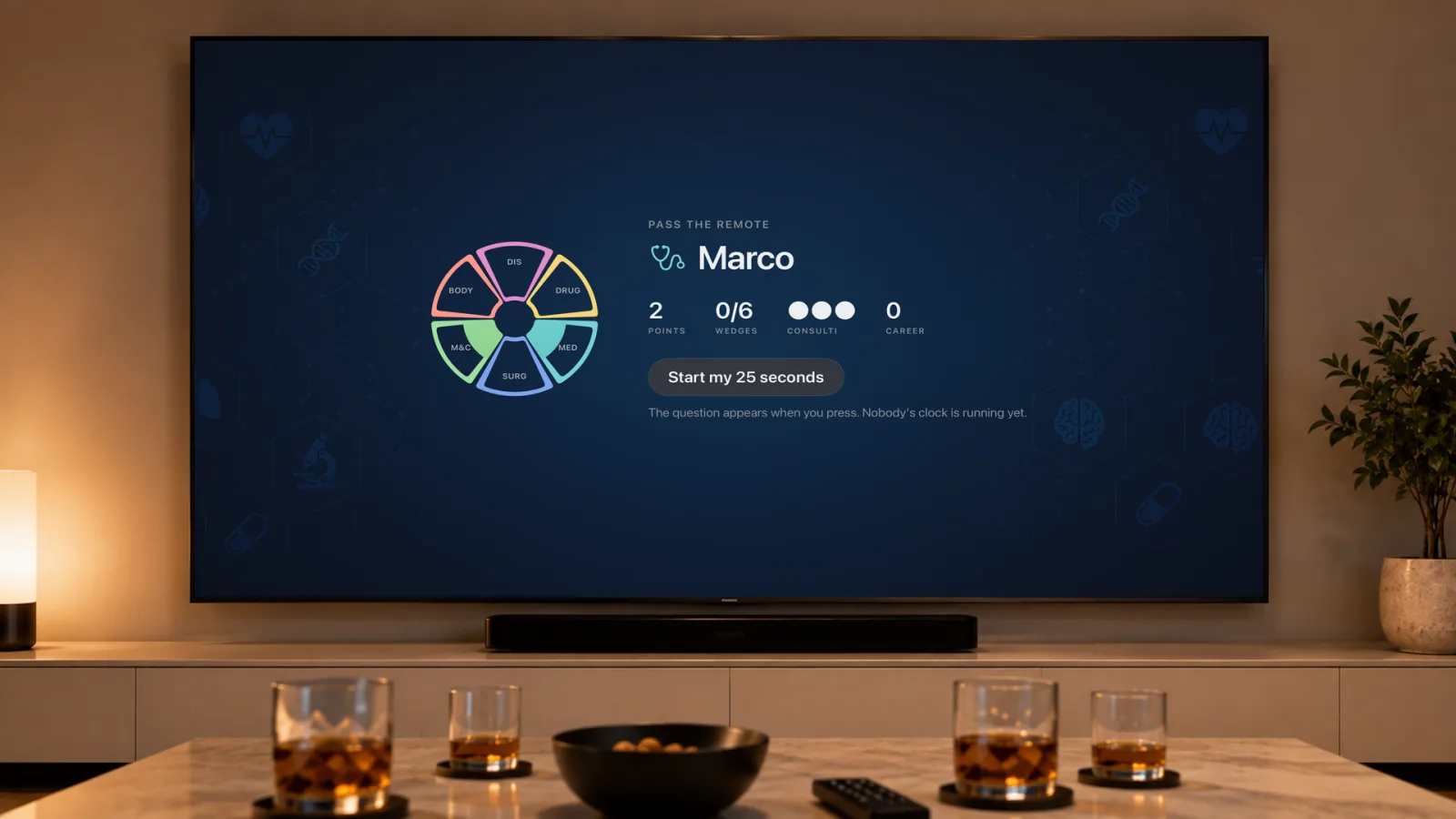
The same rules. A very different evening.
The first thing the app asks is how the room is set up. Both modes run the same question bank and the same wheel — the only thing that changes is what is in everybody's hands.
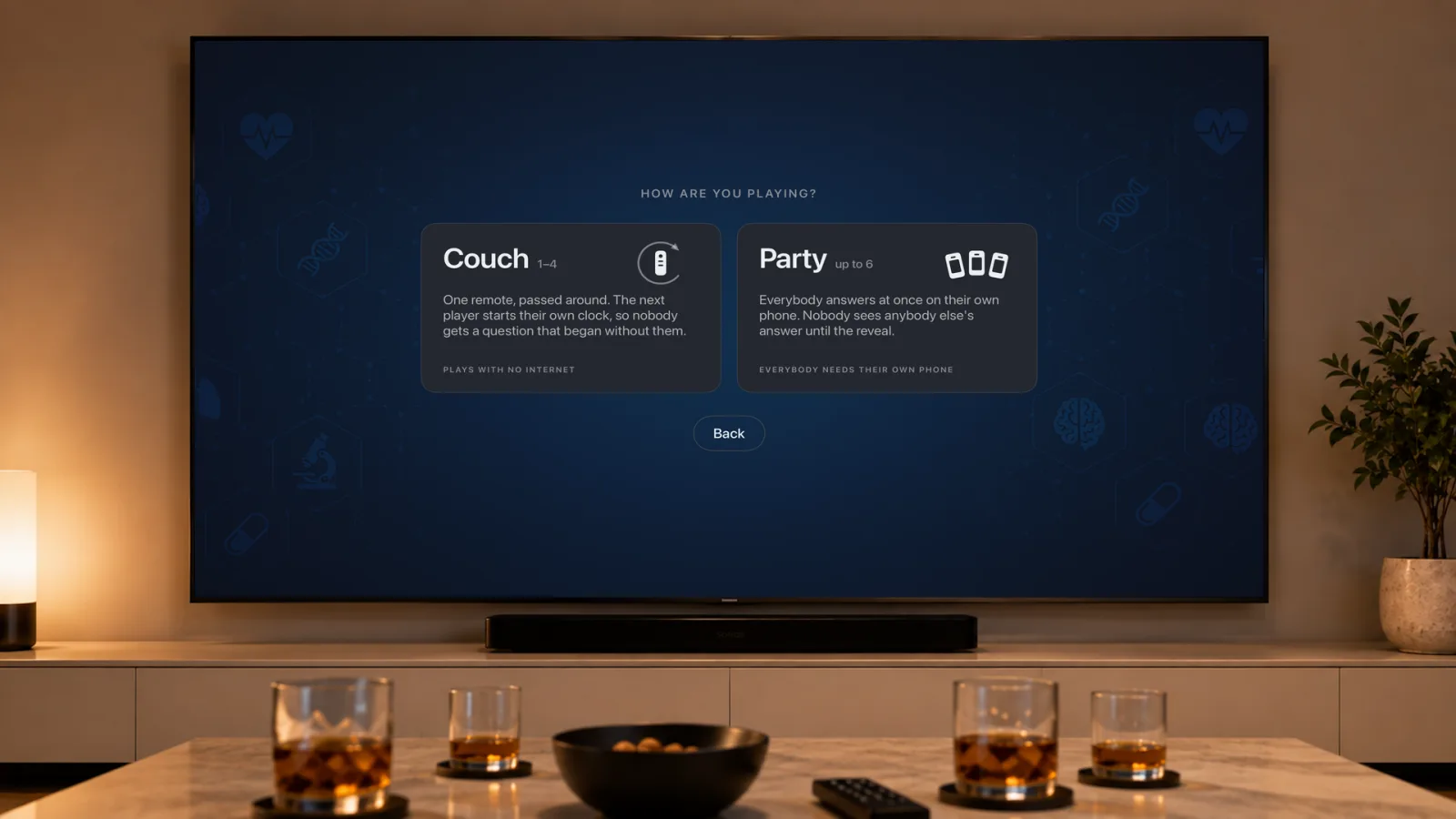
One to four players
Couch
One remote, passed around. The next player starts their own clock, so nobody gets a question that began without them.
- Plays with no internet — the questions are inside the television
- Miss it and the next player gets one shot at stealing it, never a chain
- Names, scores and career totals stay on the Apple TV and go nowhere else
Up to six players
Party
Everybody answers at once on their own phone. Scan the code on screen and the phone becomes a private answer pad — there is nothing to install.
- A web page, not an app: any phone with a camera and a browser will do
- Nobody sees anybody else’s answer until the reveal — the server refuses to hand it over, rather than the screen hiding it
- No steals, because everybody already had their go. Anyone can leave and the others carry on
In Party mode the phones are answer pads and nothing else: the question and the answers stay on the television, so the only way to see what is being asked is to look up at the screen with everybody else.
How a turn goes
Five options and twenty-five seconds is enough time to recall the answer, and exactly not enough time to reason your way to it from first principles. That is the whole design.
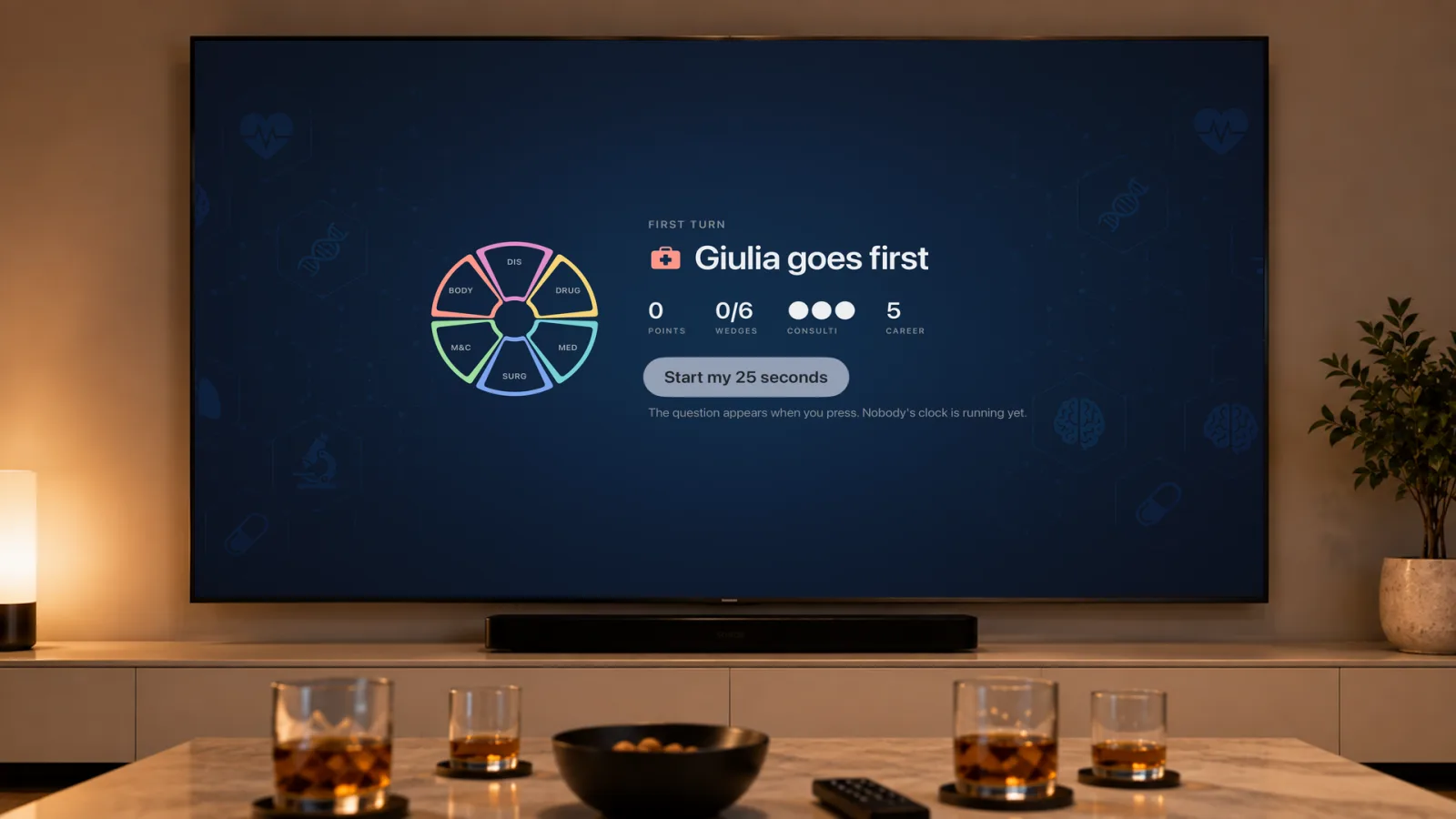
Step 1
Your clock starts when you say so
The question only appears once you press. Nobody inherits a timer that began while the remote was still crossing the room.
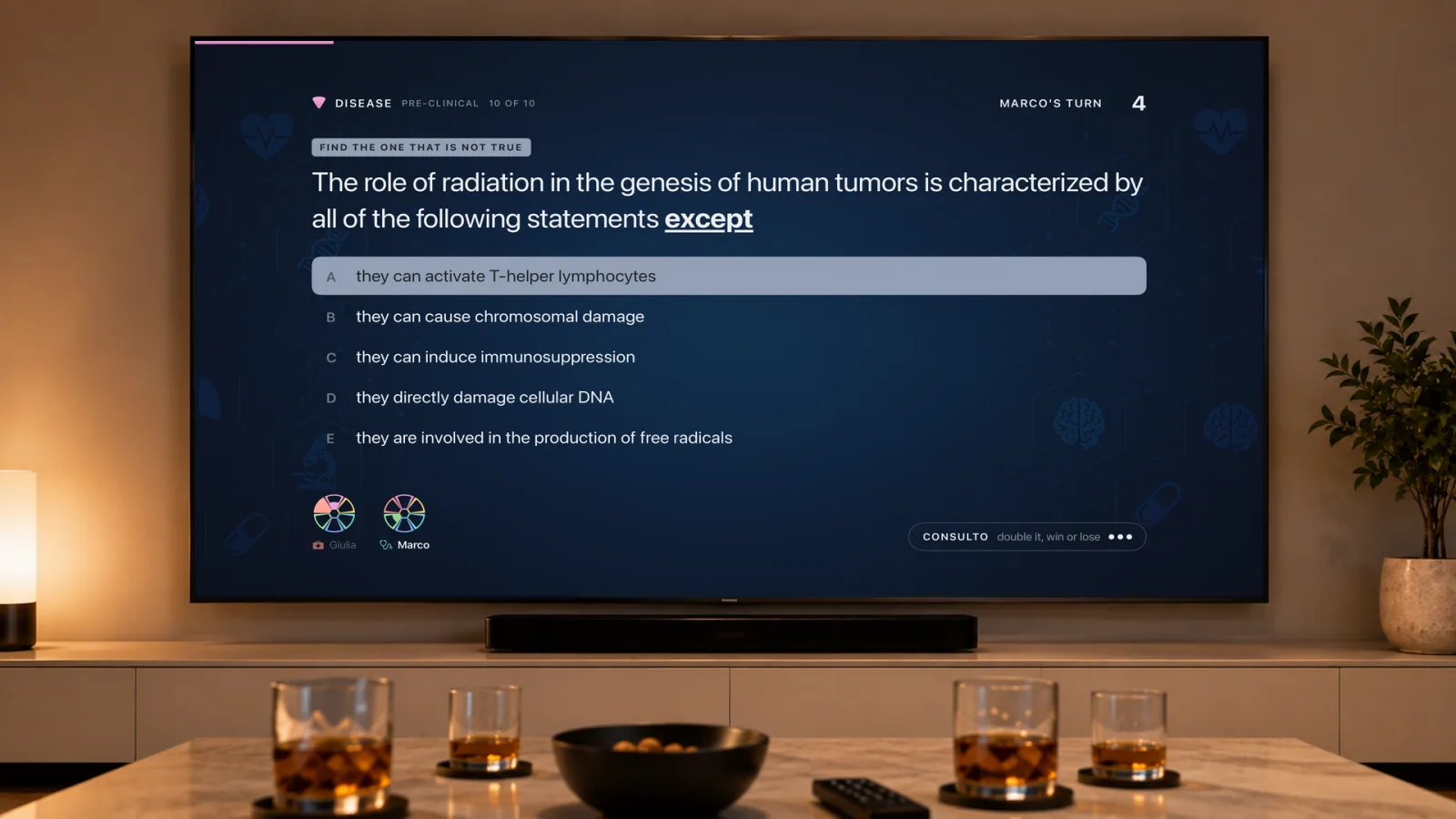
Step 2
Five options, twenty-five seconds
A bar across the top drains as you think. Negatively phrased questions are flagged outright, so nobody loses a wedge to the word “except”.
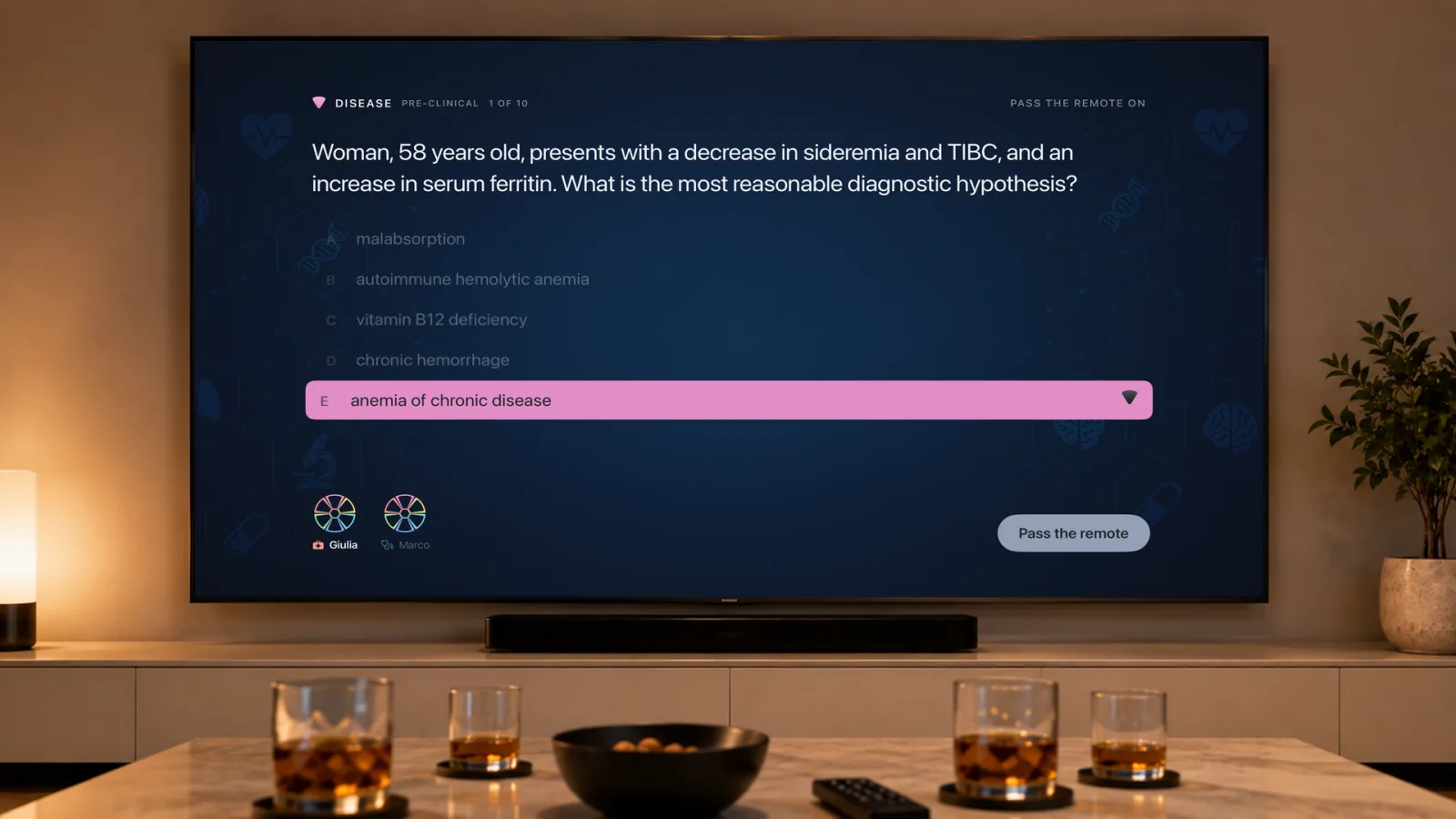
Step 3
Then the room finds out
The answer lights up in the colour of its own subject, which is the moment somebody always says they were about to pick that one.
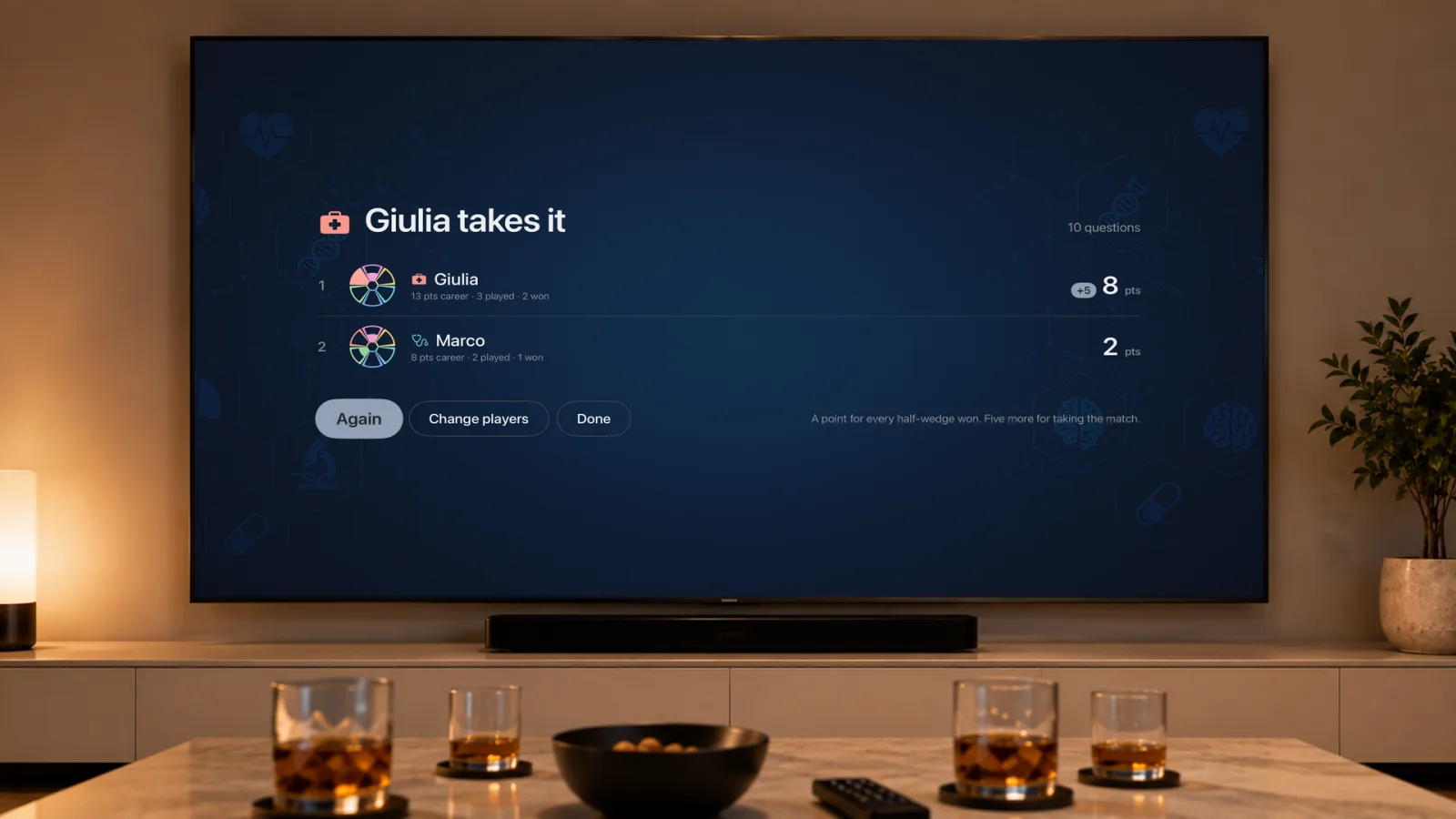
Step 4
A point a half-wedge, five for the match
The Apple TV keeps a running career for each name — points, matches played, matches won — so the rematch already has a grudge in it.
The Consulto is the one bit of strategy in the game, and it is a genuinely bad idea most of the time. Three per player, for the whole match. Spend one before you answer and you double what you win — or what you lose. Confidence has a price here, and everyone at the table gets to watch you pay it.
Who it is for
Medical students
The bank you were going to grind through anyway, answered out loud with the people you are sitting the exam beside.
Doctors and residents
A cheerful reminder of how much of the pre-clinical half quietly left the building after graduation.
Mixed tables
Bring one non-medic. The wheel makes them useless in five subjects and weirdly formidable in the sixth.
Study groups and teachers
A revision session that people turn up to on purpose, and one that ends with a scoreboard instead of a sigh.
Made to be read across a room
A television is furniture, and everybody is looking at it from a different distance and a different angle. So the wheel's colours are not decoration — they are a legibility setting.
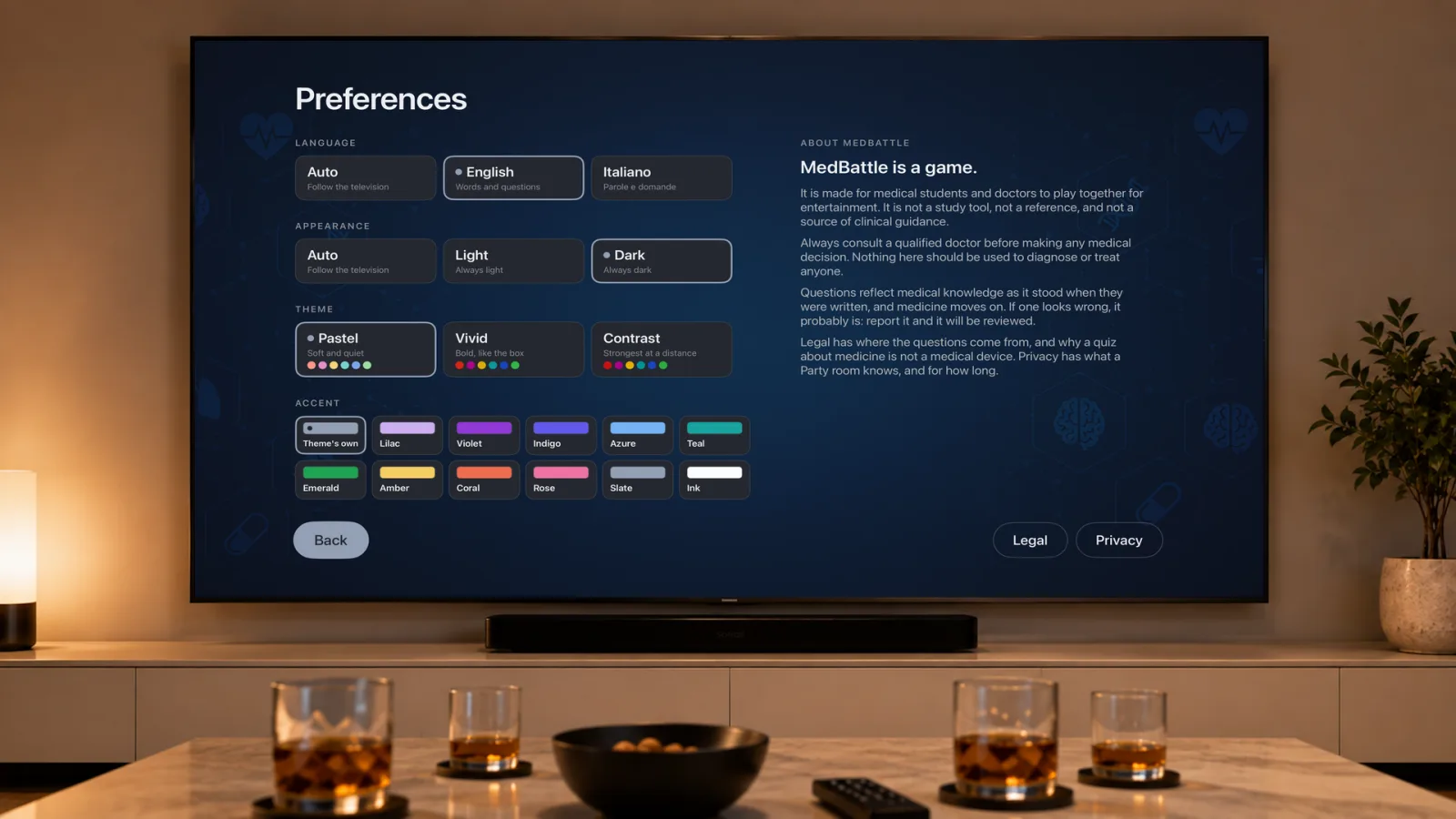
Three themes
Pastel is soft and quiet, Vivid is bold like the box, and Contrast is the strongest at a distance — for the person on the far end of the sofa.
Light, dark, or whatever the television is doing
Appearance follows the TV by default, and can be pinned either way for a room that never gets properly dark.
English and Italian
Interface and questions both, switchable mid-evening, or left on Auto to follow the television.
Eleven accents
From Lilac to Ink, if the theme’s own colour is not the one you want carrying the highlights.
Where the questions come from
All 5,931 of them come from a public state examination bank — the same material a medical graduate is examined on, not questions somebody invented to be fun. They are terse, they are occasionally unfair, and they are exactly the ones that produce an argument.
The whole bank ships inside the app, in English and Italian. Nothing is downloaded, nothing is streamed, and no question text ever leaves the television — not even in Party mode, where the phones only ever send back a letter.
At ten questions a match you will not see the end of it. That is the point: the bank outlasts the group. And the app is candid about the rest — questions reflect medicine as it stood when they were written, so if one looks wrong it probably is, and reporting it gets it reviewed.
A party game should not want to know you
There is no account, no sign-in, no profile, no analytics, no advertising and no third-party SDK collecting anything about anybody. A first name is the only thing MedBattle ever asks for, and a nickname is better.
No account, ever
No sign-up, no sign-in, no profile. Type a name at the start of the match and that is the entire onboarding.
Couch mode never goes online
A Couch match opens no network connection at all. Names, scores and careers live in the Apple TV’s own storage and are deleted with the app.
Party rooms delete themselves
Every room is written with a six-hour expiry, in Google’s European region, and is deleted the moment the match ends. There is no archive.
Nothing to sell, so nothing is sold
No email address, no phone number, no contacts, no location, no advertising identifier. No data is ever sold or used to build a profile.
Settle it on the television, not in the group chat.
MedBattle is a game, not a medical device and not clinical guidance. The questions come from a public state examination bank and are here to be enjoyed, not relied on. Nothing in the app should be used for any clinical decision.