Intrico · Apple TV · tvOS 17 or later
Find the word
nobody else saw.
Intrico is a party word game for the living room. The Apple TV shows a grid of letters; everybody scans the code on screen and traces words on their own phone, against the same clock.
Then the television tells the room what happened: a word two people found scores nothing, and a word only you found is yours.
Up to twelve players · Eight languages to play in · Nothing to install on the phones
No account · No sign-in · No analytics · No cookies
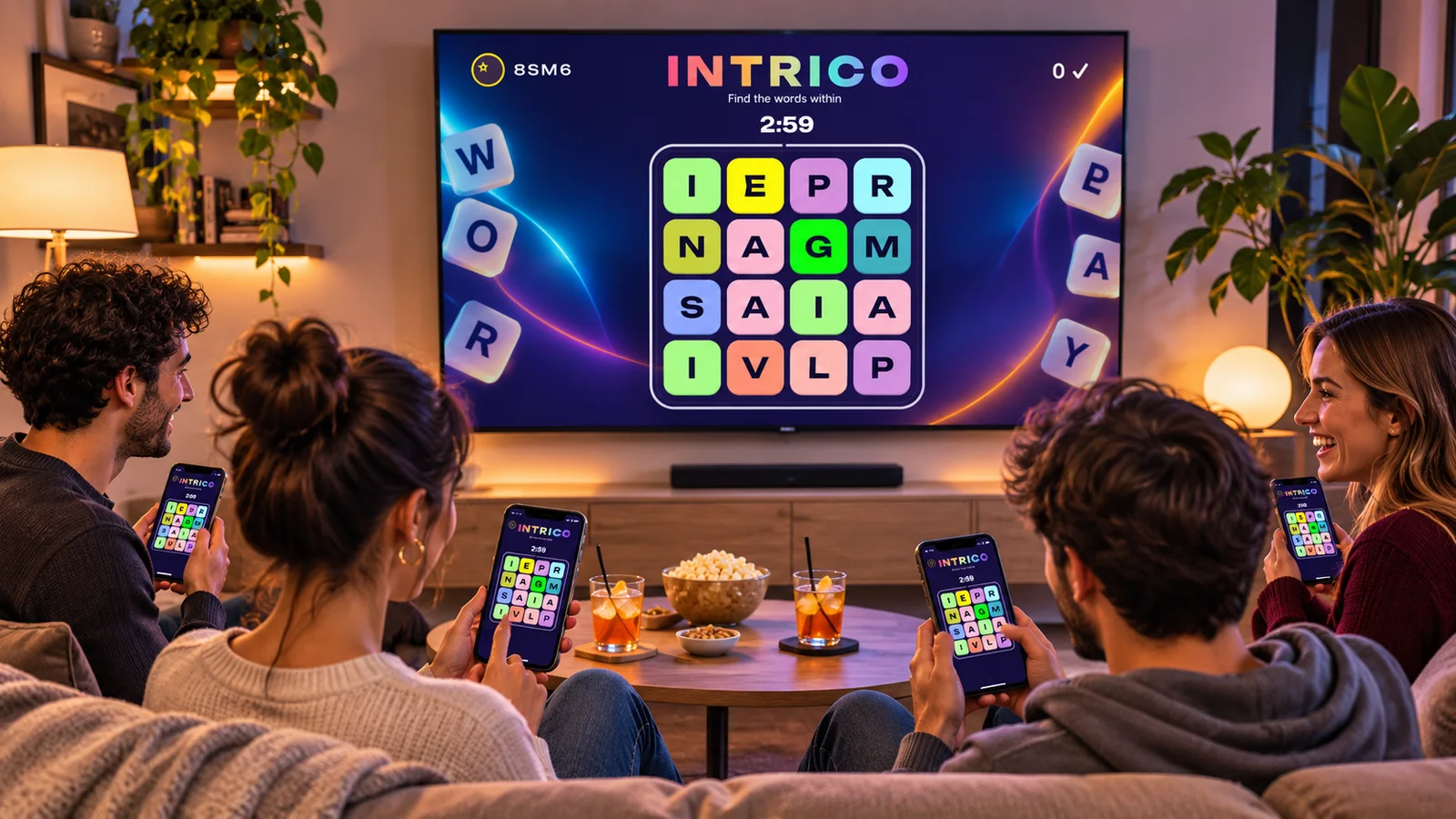
One board, a phone each
Word games on a television usually mean one remote and a lot of waiting. Here nobody waits: the letters are on the big screen and in every hand at once, and for three minutes the room goes very quiet.
The noise comes afterwards. The television goes through the round player by player, crosses out every word that more than one person found, and leaves each of you with what was yours alone. Finding many words is good. Finding the one nobody else saw is the game.
How a round goes
The television is the board and the scoreboard. The phones are where the words get made. There are four moments in a round, and only the first one needs explaining.
Step 1
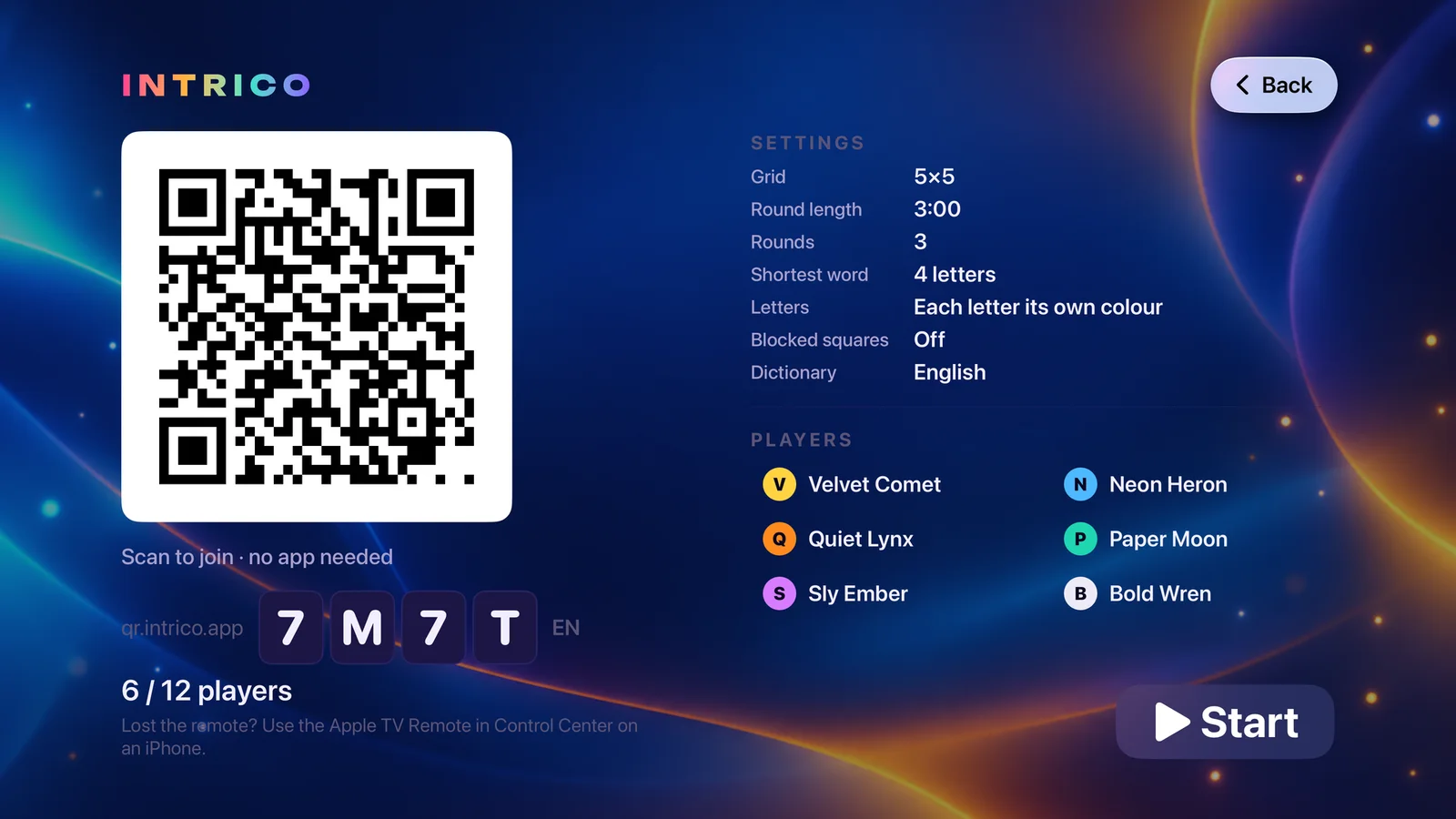
Scan the code on the television
Start a new game and a code appears. Each phone that scans it shows up on the television under a made-up name, ready to be changed or kept. Up to twelve players fit in a room.
Step 2
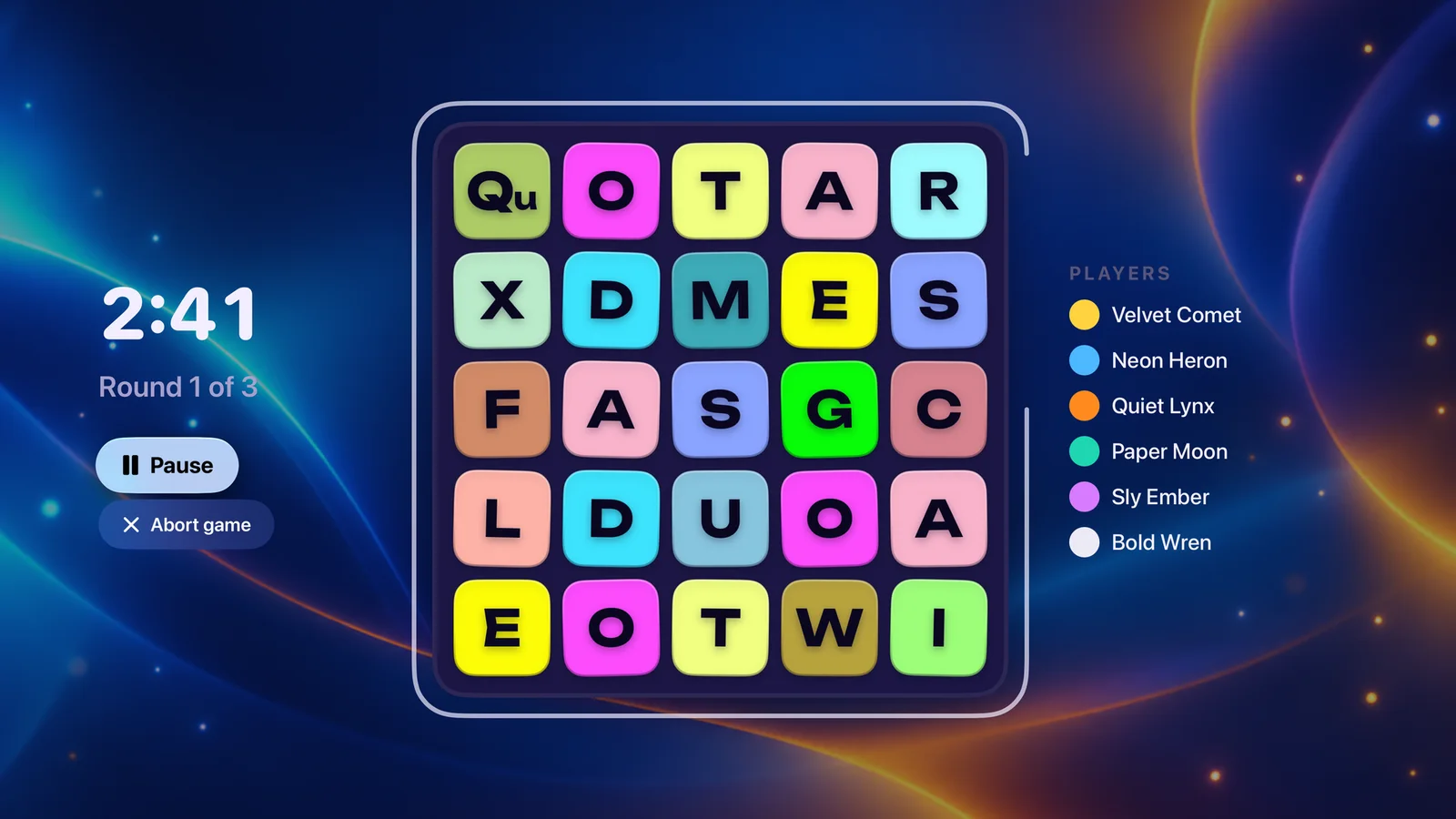
Everybody gets the same letters
After a short countdown the same board appears on the television and on every phone. The clock is on the big screen, where everyone can watch it run out.
Step 3
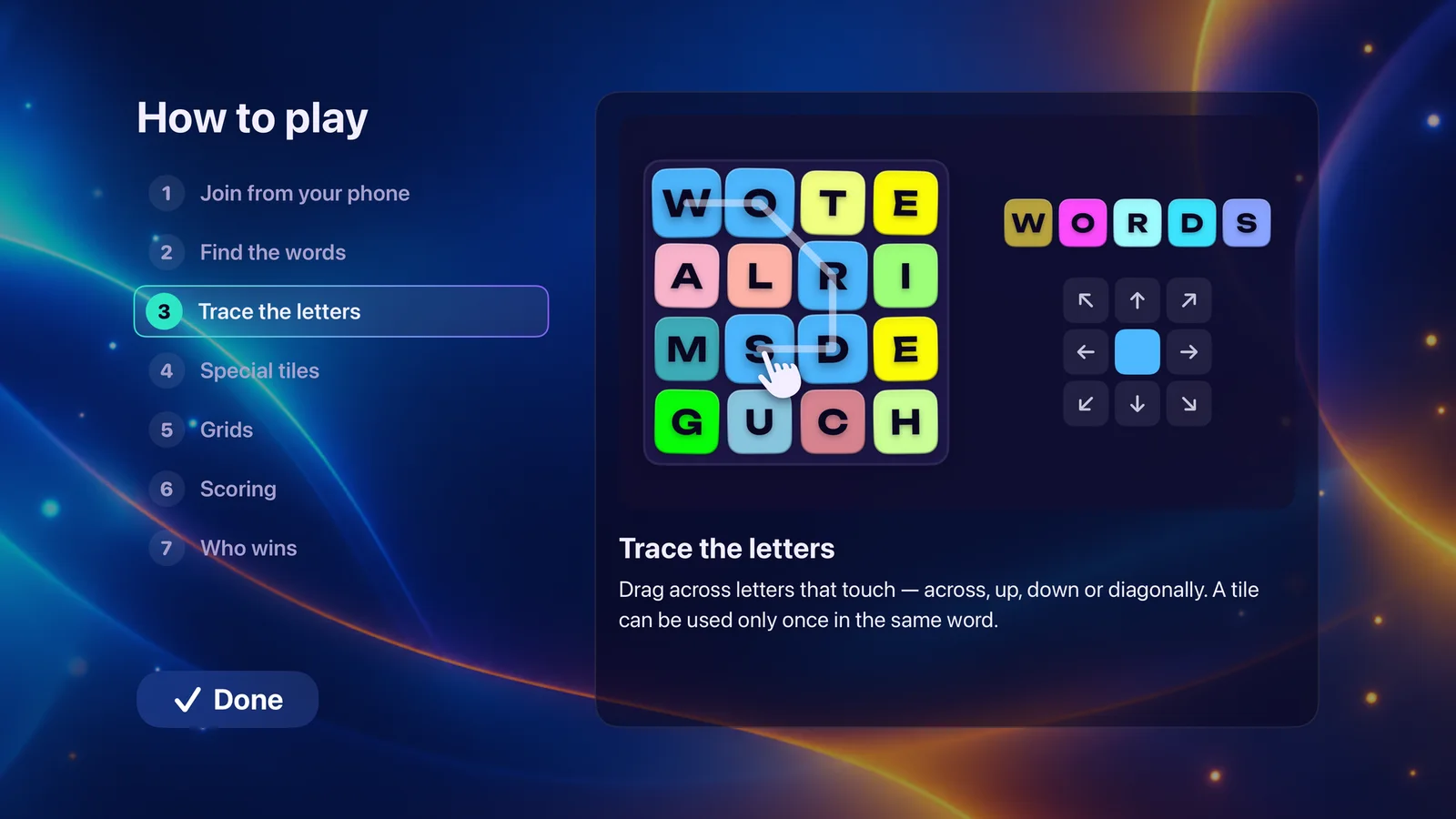
Trace words through touching tiles
Drag across letters that touch: across, up, down or diagonally. A tile can be used only once in the same word. The rules are seven short screens under How to play, for the one person who asks.
Step 4
Points add up, and the evening keeps score
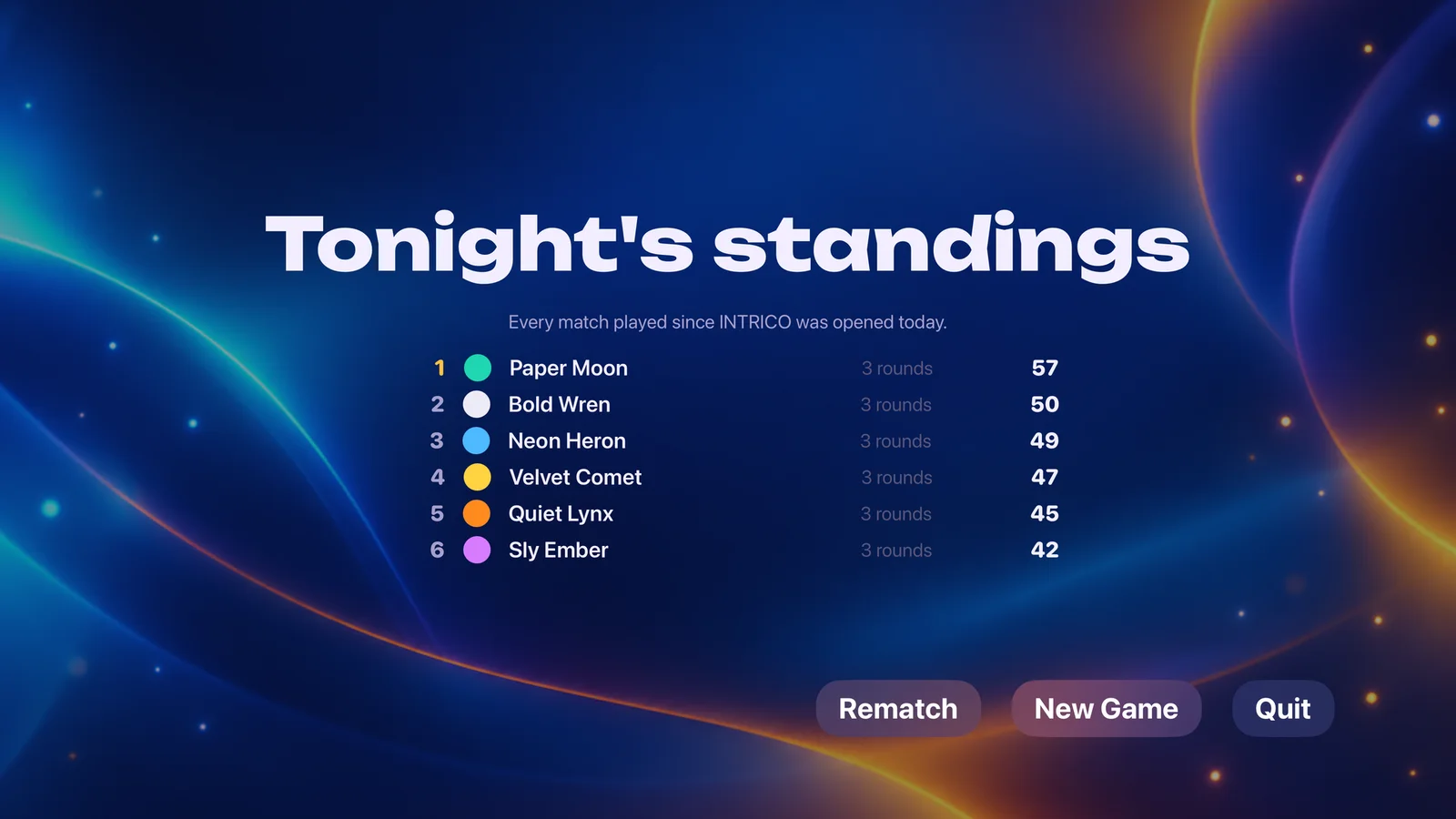
The highest total after the last round wins the match. The television also keeps tonight’s standings across every match since it was switched on, so the rematch has something riding on it.
Any smartphone, no app to install
Any smartphone will do, iPhone or Android. Point its camera at the code on the television and you are in the game: there is no app to install and no account to make, so the friend who arrives late is playing before they have sat down.
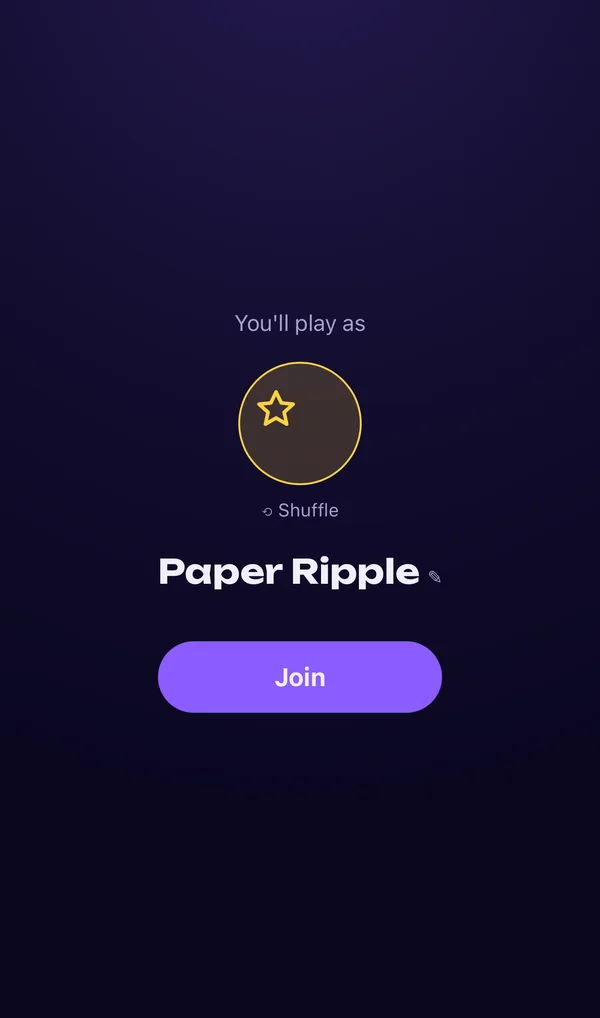
Pick a name, or keep the one you got
The game proposes a name and an avatar. Shuffle for another, type your own, or just press Join.
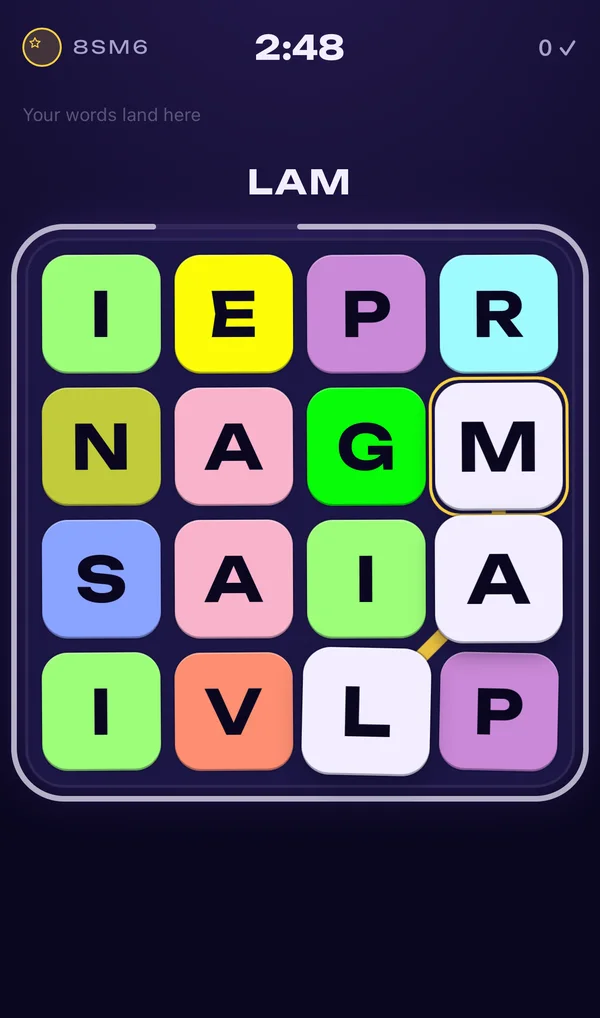
Drag a path with one finger
The tiles you pass through light up and the word builds above the board. Lift your finger and the word is checked.
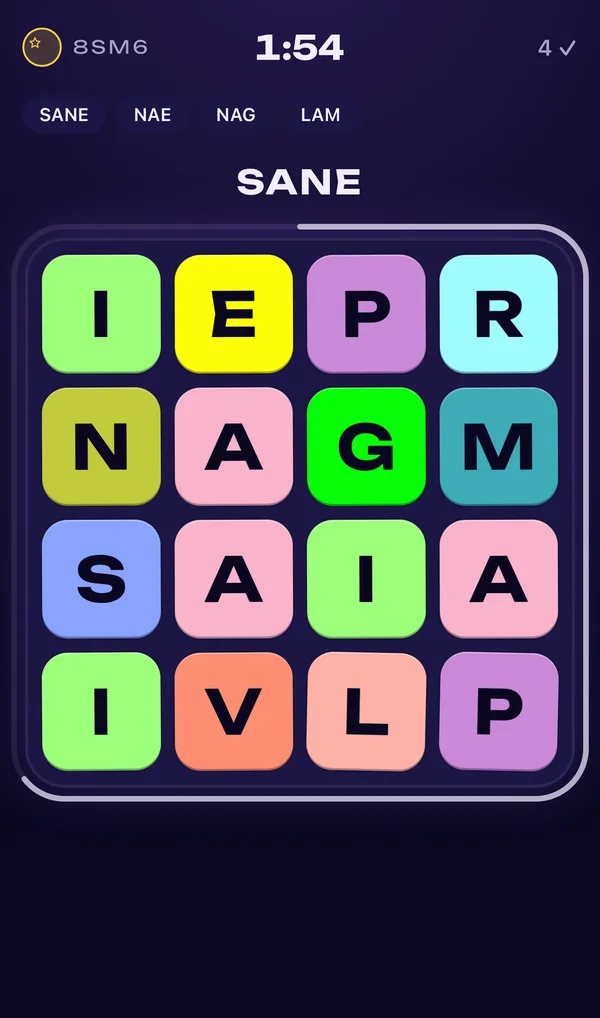
Your words pile up, privately
Accepted words land above the board. Only you can see them until time is called.
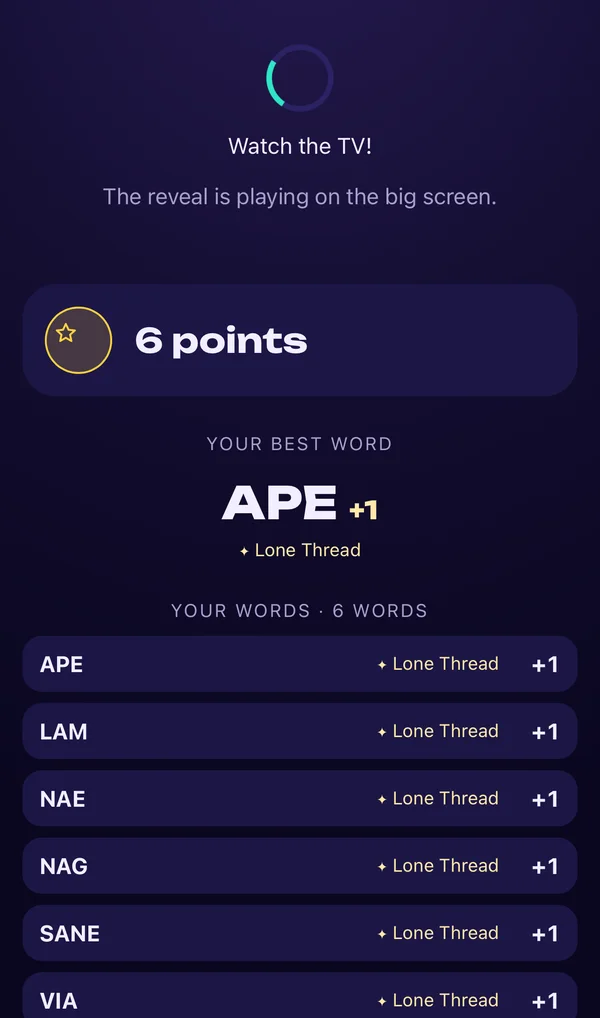
Then look up
The phone shows your own score and words. The story of the round plays on the television, for everybody at once.
Pausing from the remote hides the board on the television and on every phone and holds the clock, so answering the door costs nobody a word.
Only the Lone Threads score
A word found by two or more players is crossed out and scores nothing. A word only one player found is a Lone Thread, and it is worth more the longer it is.
So the obvious words are worth trying only if you think everyone else will walk past them, and the long one in the corner is worth the thirty seconds it takes to be sure of it.
| Letters | Points |
|---|---|
| 3–4 | 1 |
| 5 | 2 |
| 6 | 3 |
| 7 | 5 |
| 8 or more | 11 |
- Qu is a single tile and counts as two letters.
- With blocked squares on, the dark squares cannot be part of any word.
- On a tie, the player with more scoring words wins, then the one with the longest word.
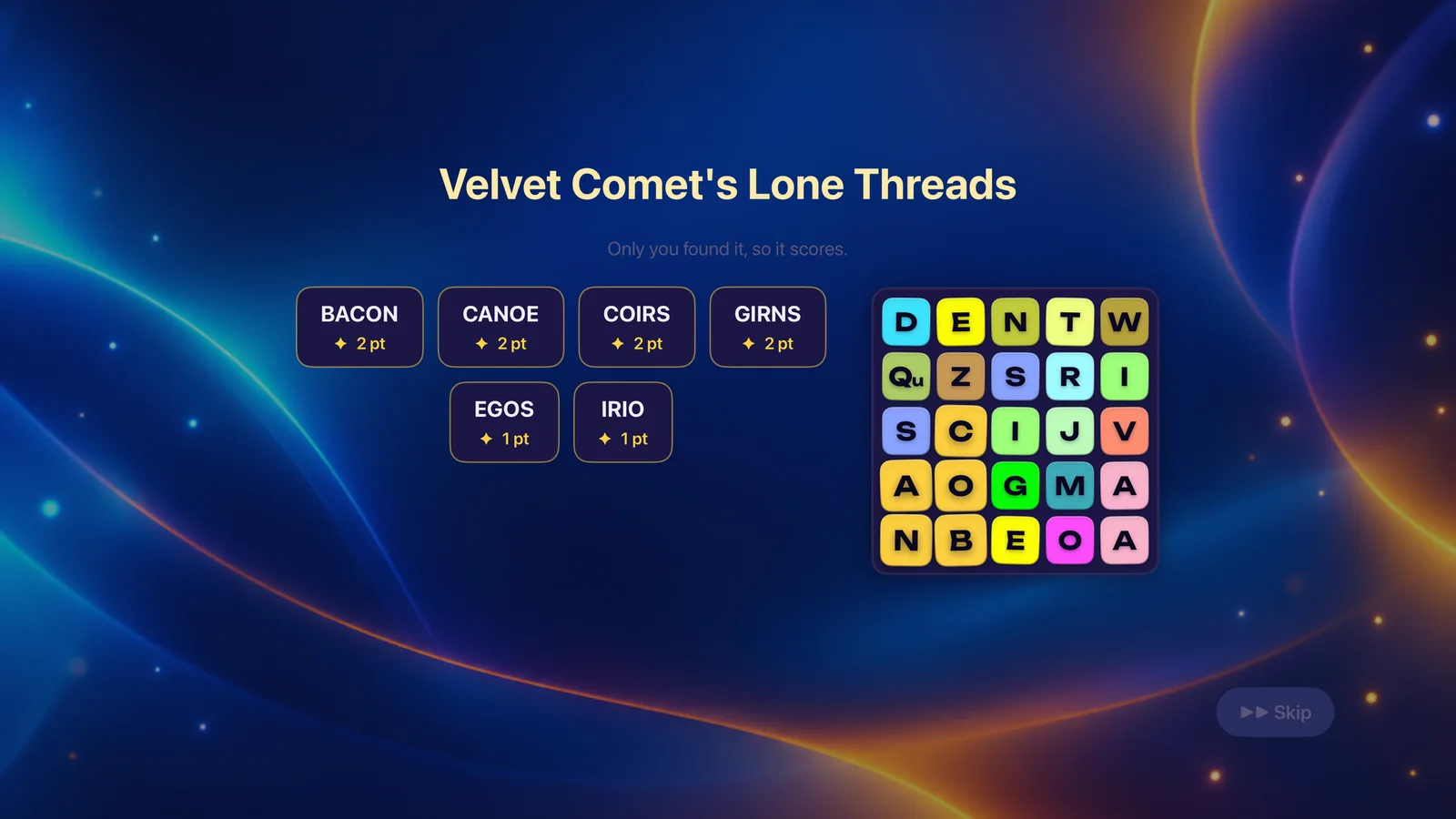
Then the television tells the story
The end of a round is not a table of numbers. It is a short show, paced so the room can react: each player's Lone Threads in turn, then what was sitting on the board the whole time, then the scores.
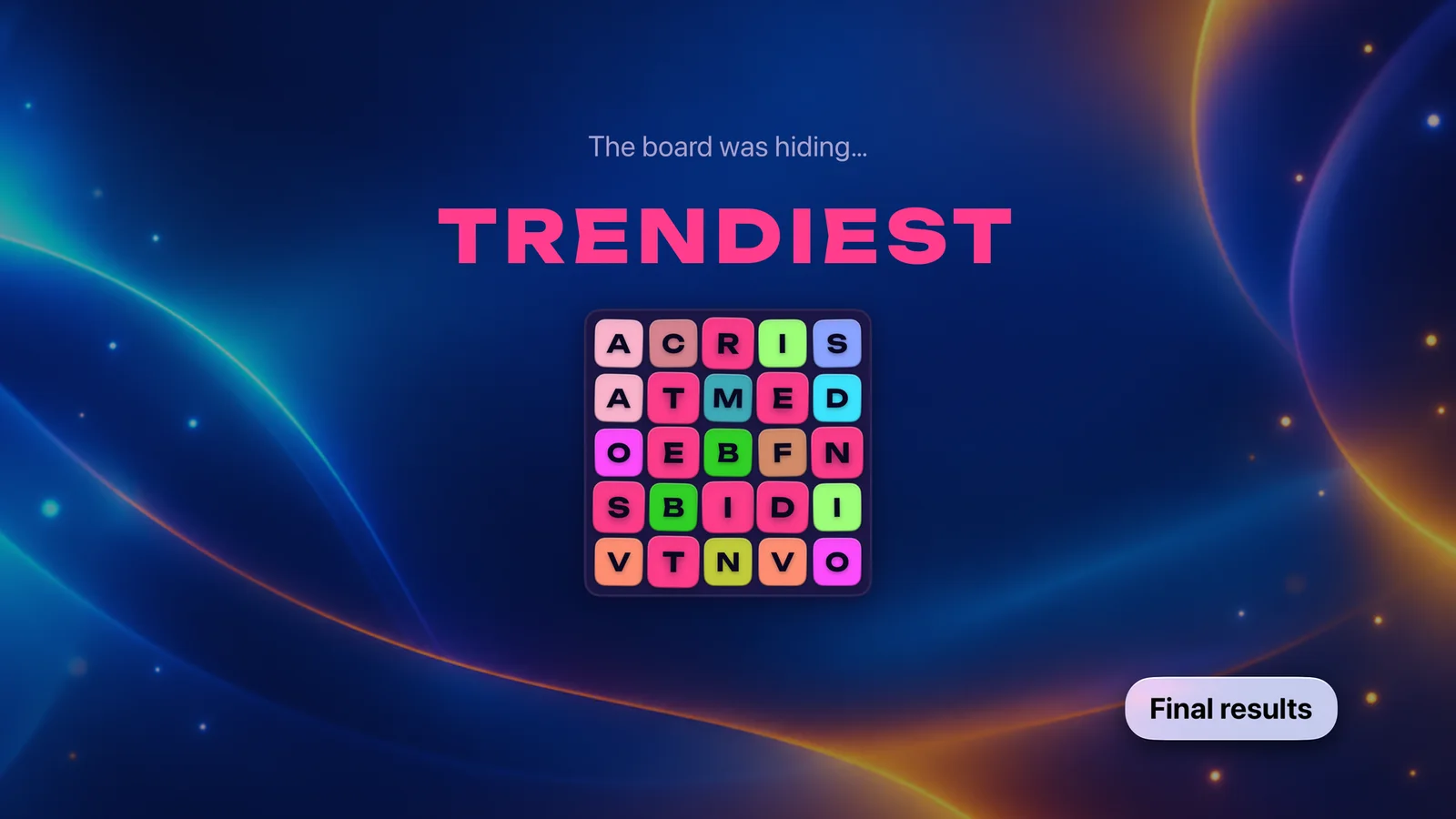
The one that got away
Before the final results, the television shows the longest word that was on the board. Usually nobody found it. Everybody says they nearly did.
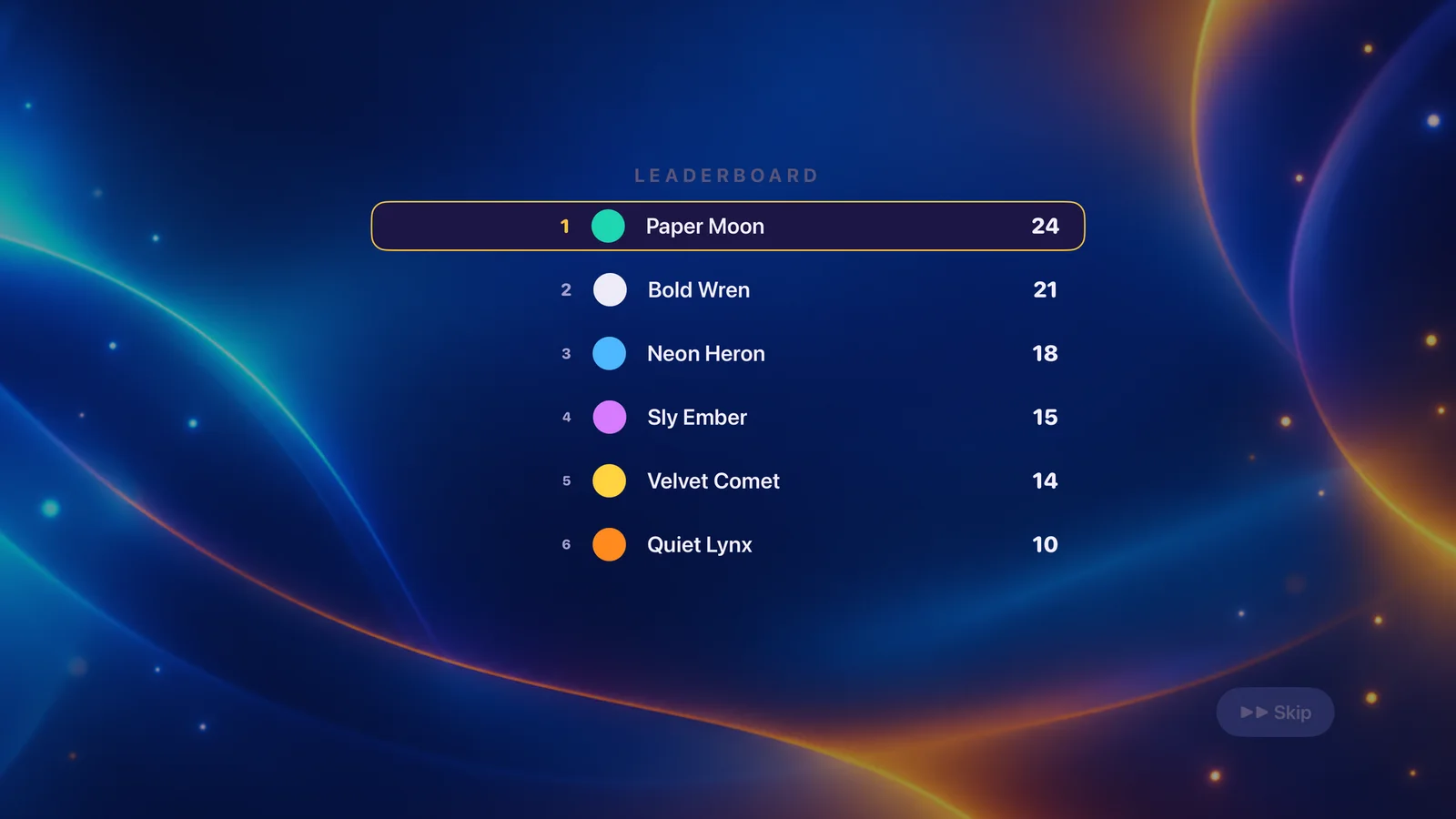
The leaderboard
Scores after every round, with the leader picked out. Three rounds is the default, and a match can be decided in the last one.
Set the table before you start
The host chooses the game in the lobby, while the others are still scanning. Every setting is shown on the television and on the phones, so nobody finds out the rules halfway through a round.
Three grids
4×4 is the classic and suits two to six players. 5×5 and 6×6 leave more room for everyone: with eight or more people on a 4×4, a word rarely stays with just one of them.
Round length, rounds and shortest word
Each grid starts with its own defaults, three or four minutes and words from three or four letters, and the host can change any of them.
Blocked squares
Turn them on and some squares go dark and cannot be crossed, which breaks up the easy paths.
Colours, sounds and music
Three colour themes, Confetti, Neon and Sunset. Each letter can keep its own colour, which makes a board easier to read from the sofa.
Eight languages, each with its own letters
A game is played in English, Italian, Dutch, French, German, Spanish, Portuguese or Latin. Each language has its own dictionary and its own mix of letters, so a Dutch board is not an English board with different words allowed.
The words are checked by the server, not by the phone, and nobody can read anybody else's words until the round is over. The word lists are family-safe, and the names players choose are filtered, so the game can stay on when the children come in.
The interface follows the television in seven of those languages. Latin is for playing only: the menus stay in whichever language you read.
A made-up name is all it asks for
There is no account, no email address and no password. The game proposes a name like Paper Ripple or Velvet Comet, and you can keep it. No advertising, no tracking, no analytics and no cookies.
No account, ever
Phones join anonymously. The game sees the name and avatar each player picks, the words they trace and their scores, and nothing else.
Games delete themselves
Everything about a game is deleted automatically 24 hours after the room closes. A game nobody is playing closes by itself.
No cookies, no banner
The phone page stores only what the game needs, such as your theme and the game you are in, so a reload puts you back at the table.
Kept in the European Union
Game data is stored on servers in Belgium and the Netherlands. No advertising, no profiling, and no data sold or shared for marketing.
Everybody saw CAT. Find the other one.